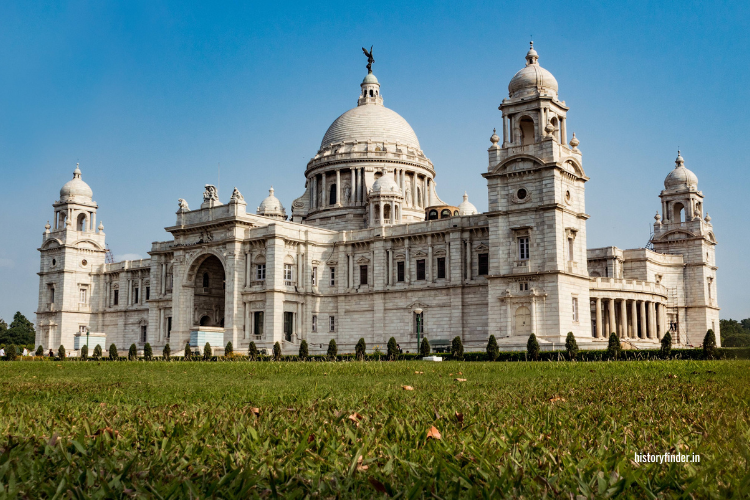
Victoria Memorial Hall is the majestic marble monument and a historical landmark of Kolkata, West Bengal, India. The stunning white marble monument was built in the memory of Queen Victoria, the Empress of British India. Now it glorifies the pride of Kolkata. Victorial Memorial also shines as the largest monument to a monark in the world. In short, the magnificient Victoria Memorial Hall of Kolkata is an emblem of British royal heritage, rich history and stunning architecture. Presently, Victoria Memorial Hall is the most-visited musuem in India.
Victoria Memorial Hall marks the imperial grandeur of British Raj in India. The fascinating memorial dedicated to Queen Victoria now acts as museum. Millions of tourists visit Victoria Memorial every year to see the original personal belongings of the Queen. The musuem also houses several paintings, memorabilia and original manuscripts.
Victoria Memorial Hall functions as an autonomous organization. It is governed by a Board of Trustees. The Governor of West Bengal serves as the Chairperson of the Board of Trustees. However, the administrative control lies with the Ministry of Culture, Government of India.
History of Victoria Memorial Kolkata
The history of Victoria Memorial Hall began with the demise of Queen Victoria in January 1901. Lord Curzon was then serving as the Viceroy of India. He decided to build a grand memorial for the Empress of British India.
Accordingly, Lord Curzon called the historical meeting on 6 February 1901 at the Town Hall of former Calcutta. His speech demonstrating his idea to built the Victoria Memorial Hall was short but detailed.
“Let us, therefore, have a building, stately, spacious, monumental and grand, to which every newcomer in Calcutta will turn, to which all the resident population, European and Native, will flock, where all classes will learn the lessons of history and see revived before their eyes the marvels of the past.”
-Lord Curzon [source: wikipedia]
Lord Curzon made the fund raiser appeal to British officials and rich Indian individuals. Victoria Memorial Hall construction cost was about 10.5 million Indian rupees (1.05 Crores) that time. Entire fund for the construction was raised from the voluntary subscriptions.
George V, the Prince of Wales, laid the foundation stone of Victoria Memorial Kolkata in January 1906. The construction of Victoria Memorial of Kolkata began in 1904 and ended in 1934. King Edward VIII, the Prince of Wales, inaugurated Victoria Memorial on 28th December, 1921. Same day, the memorial was opened for public.
Design and Construction
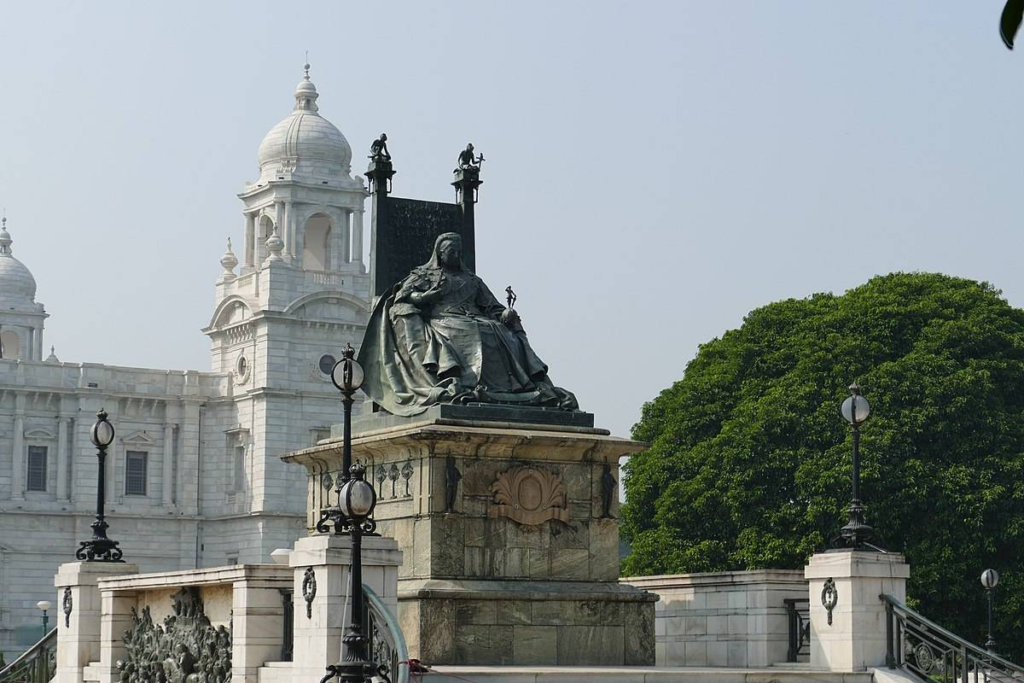
In 1903, Sir William Emerson was the chief designer and architect for design and construction of Kolkata Victoria Memorial Hall. He appointed Vincent J. Esch to assist him in design and construction of India’s busiest museum. Lord Redesdale and David Prain did the design work of the beautiful garden of Victoria Memorial. The iconic Queen Victoria statue was built by British sculptor George Frampton.
The construction of Victoria Memorial of Kolkata began in 1904 and ended in 1934.
Martin & Company of Calcutta constructed the majestic Victoria Memorial Hall of Kolkata. The construction contract was awarded in January 1904 itself. On 27th January, 1904, the excavation work began. But Lord Curzon departed from India in 1905. After his departure, things started moving very slowly. Eventually on 4th January, 1906, George V, the Prince of Wales laid the foundation of Victoria Memorial. But Curzon’s successors did not show enough enthusiasm. Hence things started getting delayed again.
In 1910, Vincent Esch was appointed as Superintendent Architect for the project. Despite of everything, the construction progressed very slowly. By December, 1921 In 1910, Vincent Esch was appointed as Superintendent Architect for the project. White Makrana marbles were brought from Rajasthan. Despite of everything, the construction progressed very slowly. By December, 1921 only the main building was completed. Even the cupolas of the corner towers were incomplete.

The surrounding garden of Victoria Memorial Hall and remaining construction of was eventually completed in 1934. English sculptor Thomas Brock made the statue of Queen Victoria placed at the central hall of the memorial.
Victoria Memorial Architecture
Victoria Memorial Hall architecture is the most elegant architectural style in Kolkata. The Italian Renaissance architecture, had a classic blend with majestic Indian Islamic architecture to produce an eye-catching beauty. Victoria Memorial Hall main dome and four octagonal chhatris have obvious influences from Taj Mahal. Venetian, Egyptian and Deccani architectural influences are also noticeable. The multi-style architectrual blend is often called Indo-Sarasenic architecture.
Lord Curzon deliberately wanted to borrow few architectural elements from Taj Mahal. The central chamber of Victoria Memorial was made larger than Taj Mahal according to his wishes. Lord Curzon intended to lift the gradure of this memorial to the Queen of Britain ahead of the memorial the Mughal Queen Mumtaz Mahal.
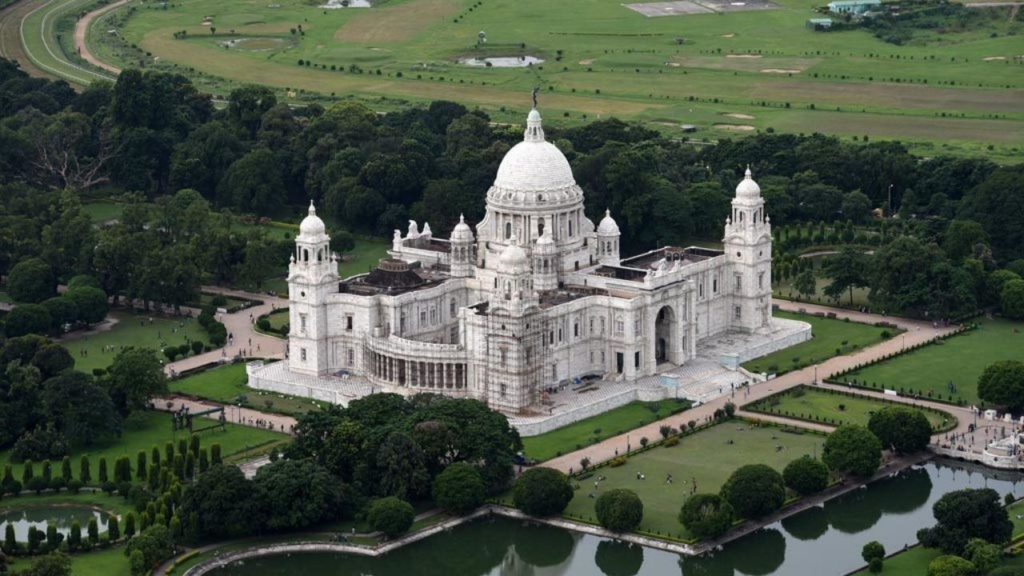
Kolkata Victoria Memorial Hall rises to the height of 184 feet (56 meters). The dimension of the memorial is 338 X 228 square feet. The central chamber has a diameter of 64 feet (20 meters). Victoria Memorial garden is also a major attraction to the visitors. The total land area of Victoria Memorial is around 64 acres.
Indo-Sarasenic Architectures are widely noticeable in 19th century constructions in India. Such mingle of Hindu, Mughal, Rajput and Gothic style are visible in Mysore Palace Architecture. Madras High Court, Chhatrapati Shivaji Maharaj Terminus of Mumbai are the other famous examples of Indo-Sarasenic Architectures.
5 Interesting facts about Victoria Memorial Kolkata
1. The Land of Victoria Memorial
Victoria Memorial was constructed on the land of Presidency Jail of Kolkata. The Presidency Jail also had a great historical significance. Indian freedom fighters like Sri Aurobindo, Netaji Subhash Chandra Bose had been imprisoned there. However, after construction of Alipore Jail, the British demolished this jail.
2. Large Contribution of Bengalees
The major donations for raising a huge fund came from the royal families of Bengal. Also, M/S Martin & Company was partially owned by Sir Rajen Mookerjee, a Bengali.
3. Special Makrana marbles
Makrana marbles are highly resistant to water seepage. And they have a great white royal look. Mughal emperor Shahjahan thus used Makrana marbles to build the Taj Mahal. Lord Curzon was already in a mood to compete with the Mughal grandeur. Anyways, M/S Martin & Company was awarded the contract to supply the white marbles. Martin & Company established special mines at Makrana, Rajasthan to dig out marbles for construction. Almost 25% of the total construction cost was spent on Makrana marbles.
4. Painted in black during World War II
On 20 December 1942 during the World war II, Japanese fighter planes started bombarding at various places in Kolkata. They majorly were targeting to destroy the Howrah Bridge and the sea port located in the city. But had also targeted and destroyed few major architectures of the city.
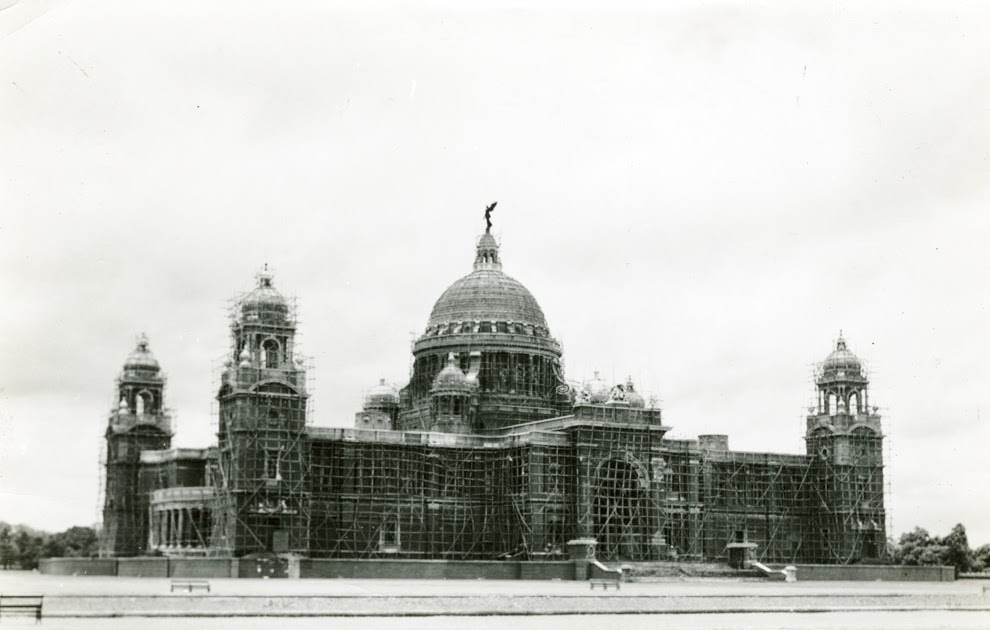
British army had quickly secured the city with air defence system for the day time. But could not provide any security for the night and needed more time to do so. Therefore, in order to protect the Queen’s memorial from the Japanese bombers, the British thinktank decided to paint the Memorial in black. Mixture of muds and cow dungs were used for the precautionary painting work.
5. Museum galleries
There are 25 galleries inside the main chamber of Victoria Memorial Hall. Some of the galleries are very special including the royal gallery, the national leader’s gallery, the portrait gallery, central hall, the sculpture gallery, the arms and armory gallery, and the newer, Kolkata gallery.
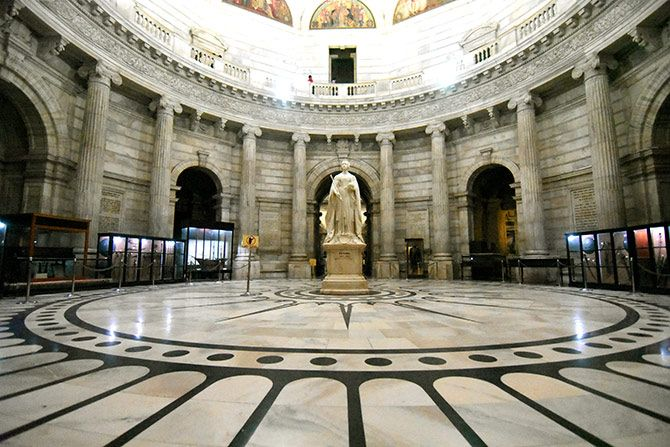
Walls of the Victoria Gallery, deeply carved with the text of Queen Victoria’s proclamation, is the main attraction. Several paintings are also there that reminds various events of her life.
Mr. Saiyid Nurul Hasan, the Minister of Education during 1970s, proposed a new Kolkata Gallery. He wanted to showcase the history of Calcutta. Later in 1986, Hasan became the Chairman of the Victoria Memorial board of trustees and also the Governor of West Bengal. With Hasan’s initiatives, the concept of Kolkata Gallery was agreed. The Kolkata Gallery finally opened in public in 1992.


Pingback: Gateway of India Mumbai -
Pingback: Mysore Palace History and Architecture - History Finder