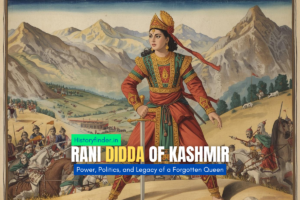
Rani Didda of Kashmir | Power, politics and legacy of a forgotten queen | Historyfinder.in

Rani Didda of Kashmir: Power, Politics, and Legacy of a Forgotten Queen

In the political history of medieval Kashmir, few rulers have generated as much debate as Didda of Kashmir. Known for her sharp political instincts and controversial decisions, she ruled the kingdom during the late 10th century and shaped its political landscape for decades. This article examines the life of Rani Didda of Kashmir, focusing on her rise to power, the political struggles she navigated, and the legacy she left behind in the history of Kashmir.
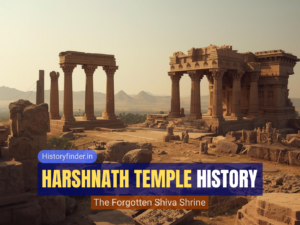
Harshnath Temple History | The forgotten Shiva Shrine of Sikar, Rajasthan

Harshnath Temple, Sikar: The Forgotten Shiva Shrine of Rajasthan

Perched on the slopes of Harsha Hill, the ruins of Harshnath Temple reveal an important chapter of early medieval India. This article explores the Harshnath Temple history, examining its 10th-century origins under the Chahamana dynasty, its architectural features in the Nagara architecture, and its religious significance as a major shrine dedicated to Shiva. Through historical evidence and architectural analysis, the story of this hilltop temple offers valuable insights into the cultural and political landscape of medieval Rajasthan.

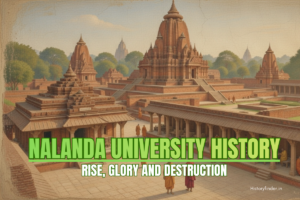
An AI generated image illustrating the ancient vibe of Nalanda University | Nalananda University History | Historyfinder.in

Nalanda University History – The Lost Intellectual Capital of Asia

For centuries, Nalanda University stood as the greatest center of learning in Asia. Kings funded it. Scholars traveled thousands of miles to enter it. Its library was legendary. And then, in a single violent turn of history, it fell. This is the history of the rise, glory and destruction of Nalanda University — a beacon of knowledge that once illuminated the ancient world.

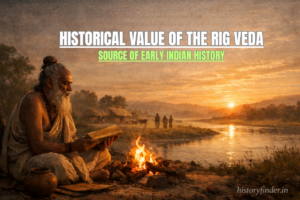
Historical Value of the Rig Veda | Historyfinder.in

Historical Value of the Rig Veda as a Source of Early Indian History

The Rig Veda is not just a sacred text—it is one of the earliest historical sources for ancient India. Its hymns reveal insights into early Vedic society, tribal politics, religion, economy, and geography, making it indispensable for reconstructing the Rig Vedic age.

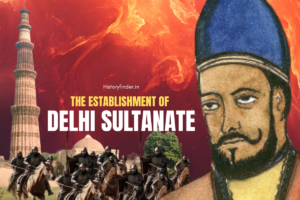
The establishment of Delhi Sultanate | Historyfinder.in

Establishment of the Delhi Sultanate: How a New Era Began in India

The establishment of the Delhi Sultanate in 1206 marked a turning point in Indian history. After the death of Muhammad Ghori, his general Qutb-ud-din Aibak laid the foundation of a new political order in northern India. This event began nearly three centuries of Sultanate rule and reshaped medieval India.

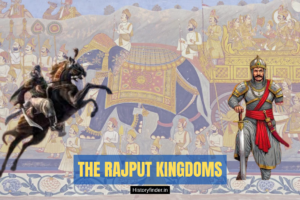
The Rajput Kingdoms of India | Historyfinder.in

Rajput Kingdoms: History, Culture, Dynasties and Their Legacy

The Rajput Kingdoms shaped medieval India through their warrior traditions, grand forts, powerful clans, and enduring codes of honour. This article explores their origins, major dynasties, cultural identity, political struggles, and the legacy they left behind in Rajasthan and beyond.

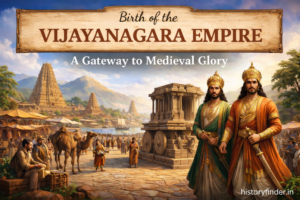
An illustration showing the birth of the Vijayanagara Empire in 1336, with Harihara I and Bukka Raya I standing before the capital city of Hampi, featuring the Virupaksha Temple, bustling markets, and trade routes along the Tungabhadra River.

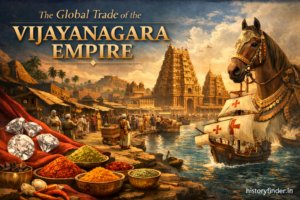
How Vijayanagara Empire Was Born: History of A Grand Revival

The birth of the Vijayanagara Empire in 1336 marked a turning point in South Indian history. Founded by Harihara I and Bukka Raya I, the empire rose from political collapse to become a center of military strength, cultural revival, and global trade. From the strategic choice of Hampi as its capital to its influence beyond India, this article explores how Vijayanagara emerged as one of the greatest civilizations of the medieval world.

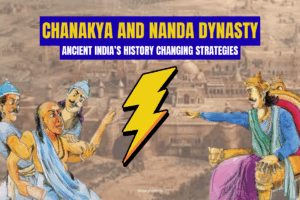
Chanakya and Nanda Dynasty: Ancient India's History Chaging Strategies

Chanakya and Nanda Dynasty: Ancient India’s History Changing Strategies

In the heart of ancient Magadha, power had reached its peak under the Nanda dynasty. Even foreign travelers spoke of its overflowing treasuries and vast armies. Born from humble origins, the Nandas rose through ambition and sheer political cunning, turning Pataliputra into the heart of Indian power. Yet this grandeur transformed into history’s greatest confrontations

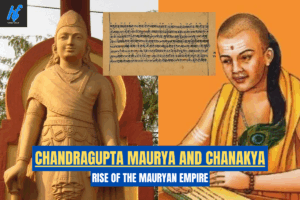
Chanadragupta Maurya and Chanakya - the rise of Mauryan empire

Chandragupta Maurya and Chanakya: Rise of the Mauryan Empire

“From a young boy of uncertain origins to the founder of India’s first great empire, the journey of Chandragupta Maurya is a history of ambition, strategy, and vision.” The history of Chandragupta Maurya begins in a turbulent period of northern India. Alexander’s invasion had left its mark— a historical phase where fragmented kingdoms struggled for

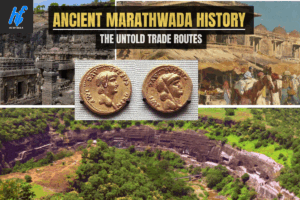
Ancient Marathwada History – The Untold Trade Routes | Historyfinder.in

Ancient Marathwada History – The Untold Trade Routes

The history of ancient Marathwada is woven through its trade routes, where Paithan (Pratishthana) thrived as the Satavahana capital. From its markets flowed silks, spices, and beads that reached Rome, Persia, and beyond, leaving behind Roman coins and timeless legends. Trade wealth also funded culture — from the splendor of Paithani sarees to the murals of Ajanta caves. Though the routes declined with shifting powers and rising maritime trade, their legacy endures. Each Paithani saree woven today carries threads of that golden era, binding Maharashtra’s present with its ancient global past.

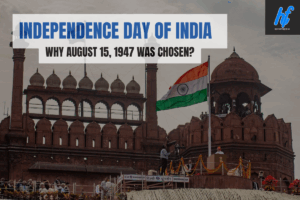
Independence Day India: Why the date August 15, 1947 was chosen?

Independence Day of India: Why August 15, 1947 Was Chosen?

India’s independence was declared on August 15, 1947 because Lord Mountbatten, the last Viceroy, chose the date to mark the second anniversary of Japan’s surrender in World War II. This “Victory over Japan Day” was considered lucky by Mountbatten, making it the symbolic date for India’s freedom from British rule.

Vedic Wisdom Explained: Ancient Insights for Modern Life | Part-1

Vedic Wisdom Explained: Ancient Insights for Modern Life

Vedas are the collection of the oldest known sacred texts in the world. Vedic texts refer to a vast collection of hymns, composed in Vedic Sanskrit — the earliest layer of Sanskrit. The Vedas also mark the foundation of divine Sanatana (eternal) Dharma (righteousness), which later formed Hinduism. Vedic wisdom elaborates the eternal quest for truth,

The Bhils of India- from bows to brushes | Historyfinder.in

The Bhils of India: A Rich Culture From Bows To Brushes

The tribal heritage of India is incomplete without acknowledging the Bhils. They are the largest, indigenous, and ancient tribe who are strongly suriving in India. The identity of the Bhils date back to the ages of Ramayana that states about Bhil settlement at Dandakaranya nearly around 7,000 BCE. But the Bhils now have a wider

Jhalkari Bai Life History | Historyfinder.in

Jhalkari Bai Life History: The Braveheart Who Fooled the British

Jhalkari Bai was a prominent but unsung warrior of 19th-century. She played a crucial role in the Indian Rebellion of 1857, particularly during the Siege of Jhansi. Jhalkari Bai born to a Dalit Kori family near Jhansi. From there she became a close advisor to Rani Lakshmi bai. While the history of the Dalits is

Surat Raids by Shivaji Maharaj: The Debated Legacy

Surat Raids by Shivaji Maharaj: The Debated Legacy

The Surat raids of Shivaji Maharaj unleash two of his bold and strategic military expeditions. These campaigns showcase his brilliance in guerrilla warfare. Surat was a thriving commercial hub of the mighty Mughal empire then. Shivaji Maharaj chose to raid Surat, not just for wealth, but also as a symbolic target to assert Maratha power.

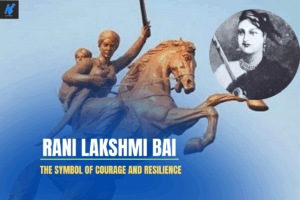
Rani Lakshmi Bai of Jhansi

Legacy of Rani Lakshmi Bai: 10 Things You Must Know

Rani Lakshmi Bai was a prominent figure of 19th century in Indian history. She was the Queen of the princely state of Jhansi. Her bravery and patriotism, particularly for the defense of Jhansi, inspired countless people to join the independence movements in India. The warrior queen of Jhansi was one of the iconic leaders of the Indian Rebellion of 1857. The legacy of Rani Lakshmi Bai remains a symbol of courage, resistance, and patriotism.

Scroll to Top