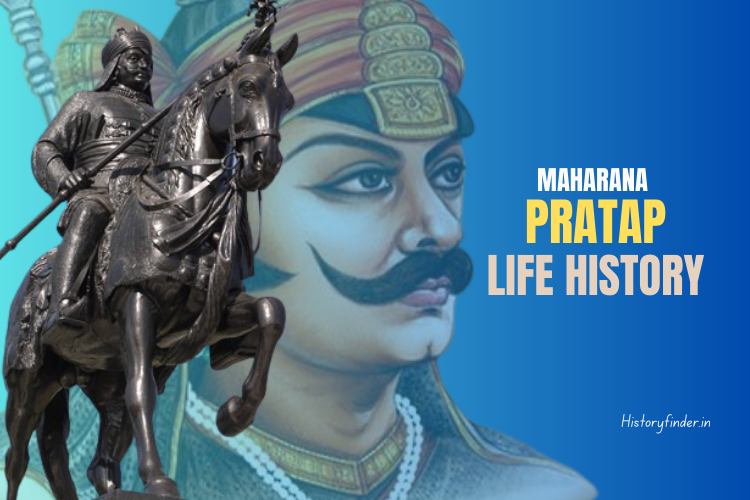
Maharana Pratap Singh was a symbol of supreme loyalty, courage, prowess and valor. The greatest Rajput warrior was lethal to his enemy, loyal to his motherland and caring to his people. But what made the life history of Maharana Pratap look remarkable, was his lifelong struggle. He chose the hardest way to live his life, against thousands of odds. Above all, the legendary king was icon of sacrifice – he sacrificed all kingly comfort and pleasure for his homeland.
Maharana Pratap was the greatest warrior king of Mewar for a reason. He devoted his life to fight against the mightiest power of India that time. Badshah Akbar tried several temptations – offering power, position and wealth. But Maharana refused every single offer of Akbar, to surrender his motherland under Mughal suzerainty. Akbar invaded Mewar, captured Chittor. Homeless Maharana Pratap refuged to the forests of Aravalli but continued his fight for freedom.
The nation thus respects Maharana Pratap as a National Hero. On Maharana Pratap Jayanti every year, every Indian recall the toughest life history of Maharana Pratap.
Family History of Maharana Pratap
Maharana Pratap was born on 9th May in 1540 at Kumbhalgarh Fort. The entire nation celebrates Maharana Pratap Jayanti on his date of birth.
Maharana Uday Singh-2, father of Maharana Pratap was 12th Maharana of Sisodiya Rajput dynasty. Maharani Jaiwanta Bai, mother of Maharana Pratap, belonged the Chauhan dynasty of Jalore. Maharana Pratap was the first child to Maharana Uday Singh-2 and Maharani Jaiwanta Bai. He had three stepbrothers – Shakti Singh, Vikram Singh and Jagmal Singh and two stepsisters – Chand Kanwar and Man Kanwar.
Maharana Pratap had 11 wives – a common, royal practice then. In most cases, marriage was a strategic decision to maintain diplomacy with other royal families. Maharani Ajabde Bai Punwar of Bijolia was his chief consort. Maharana Pratap has total 27 children including 22 sons and 5 daughters. Amar Singh was the first child of Maharana Pratap, who succeeded the throne of Mewar after his death.
Here is the full list of 11 queens of Maharana Pratap Singh:
- Maharani Ajabde Bai Panwar
- Rani Phool Bai Rathore
- Rani Solankhinpur Bai
- Rani Champa Bai Jhala
- Rani Jaso Bai Chauhan
- Rani Alamde Bai Chauhan
- Rani Asha Bai Khichar
- Rani Shahmati Bai Hada
- Rani Ratnawati Bai Parmar
- Rani Lakhi Bai Solanki
- Rani Amar Bai Rathore
10 Less Known Facts About Maharana Pratap Singh
Maharana Pratap was a man of incredible character. People often remember Maharana Pratap for his brave, lifelong resistance to Mughal expansion at Mewar. But there are some lesser known aspects of Maharana Pratap life that makes him more respectful. Here are 10 intriguing lesser known facts about Maharana life history:
1. Tiger Hunting Stories of Maharana Pratap
Hunting was a major hobby of Maharana Pratap. Several legends exist on young Maharana Pratap and his tiger hunting story, which actually symbolize his fearlessness.
One legendary tiger killing story on young Maharana Pratap was about a tiger attack when he went for hunting with his stepbrother Shakti Singh. Scared Kuwar Shakti was fully shocked and was unable to protect himself. But Kunwar Pratap had very strong nerves to stand strong against the wild tiger. After a terrible fight, the sword of Maharana Pratap proved stronger than the deadly paws of the tiger.
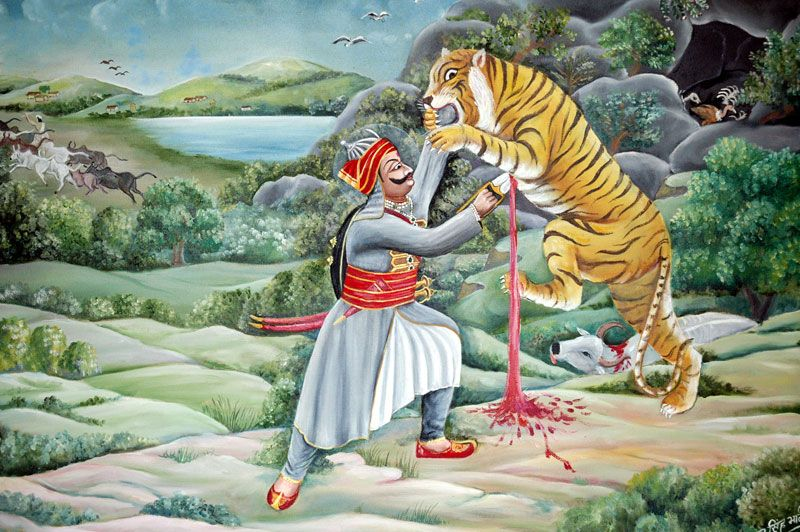
Another Maharana Pratap tiger hunting legend is famous in Rajasthan. While visiting house of his friend Chakrapani, Maharana Pratap heard that a tiger dragging away children from a nearby village. The ‘guest’ Maharana Pratap never forgot his dharma. He went into the jugle, hunt down the tiger and brought relief to the villagers.
2. Resistance in Ascending the Throne
Being the eldest son of the family does not mean you have smooth access to the throne!
After Maharana Uday Singh died, Rani Dheer Bai Bhatiyani wanted her son Jagmal Singh to ascend the throne of Mewar. It created a long debate across the nobles and the aiders of Rani Dheer Bai. But the future of Mewar was also at stake. So, Mewar needed someone who had the guts to face the mighty Mughals. Hence, majority of the nobles chose Pratap Singh as the heir of Rana Uday Singh II. Finally, on 28th February, 1572, Maharana Pratap ascended the throne, as 13th Sisodiya ruler of Mewar.
3. Maharana Pratap Height and Weight
The world is curious to know the actual height and weight of Maharana Pratap!
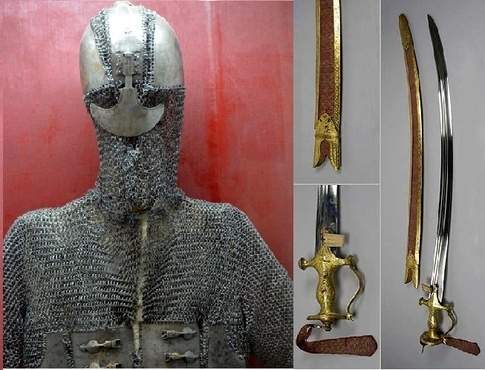
No historical account about Maharana Pratap has mentioned about his actual height and weight. However, his armors preserved at Maharana Pratap Museum aka Haldighati Museum gives a fair idea. He was a strongly built warrior – whom a very few enemy will dare to face. The armors of Maharana Pratap indicate that he was about 7 feet 5 inches tall, and his weight was around 110 kg.
4. Maharana Pratap Sword and Armor
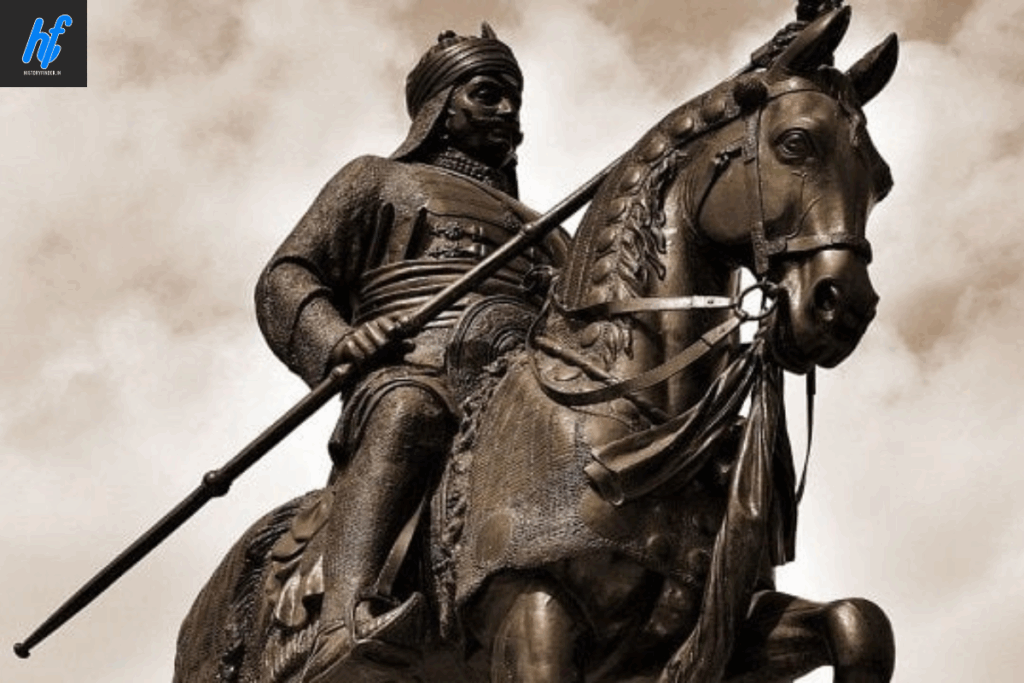
The swords of Maharana Pratap, that cut enemies into pieces, weighted 25 kg each. The armor that was impregnable to the enemies weights about 75 kg. And this is not the end. His massive spear weighted about 81 kg. These killing materials are all preserved at Haldighati Museum, Udaipur.
He would carry two swords and one spear in the battle field. So, the total weight of his armor and weaponry was about 208 kg. These all signify a galore of stamina what Maharana Pratap had. He was not a mere back-end commander, but a front-end warrior.
5. Saying NO to Akbar
Badshah Akbar wanted a safe route connectivity from Agra to Gujarat, the one of the largest trade hubs. But the geographical location of Mewar was not allowing it. So, Akbar wanted Mewar under his control, by hook or by crook. This led Akbar sent five diplomatic missions to Maharana Pratap between 1572 and 1576, to accept his suzerainty.
Maharana Pratap had the guts to say NO to Badshah Akbar. His response was simple but firm – independence of Mewar at any cost. In 1576, Badshah Akbar sent Raja Man Singh of Amber, as the negotiator of his fifth and final diplomatic approach. Maharana Pratap too wanted peace, but not against Mewar’s freedom. He sent his son Amar Singh to Akbar’s court with return peace proposal. His intention was again simple – show respect in rejection. But the peace mission eventually failed, inflicting the famous Battle of Haldighati.
6. Legend of Killing Behlol Khan
The Battle of Haldighati (18th June, 1576) was a matter for survival of Mewar. Badshah Akbar sent a large troop under the command of Raja Man Singh of Amber.
The battle of Haldighati ended indecisively. But the valor of Maharana was extraordinary at the battlefield. A famous legend of Maharana Pratap killing Mughal commander Behlol Khan is very famous in Rajasthan. Maharana Pratap is said to cut Behlol Khan in two pieces along with his horse, with a single swing of his sword. Another slightly different legend describes that Maharana Pratap beheaded Behlol Khan in a single shot.
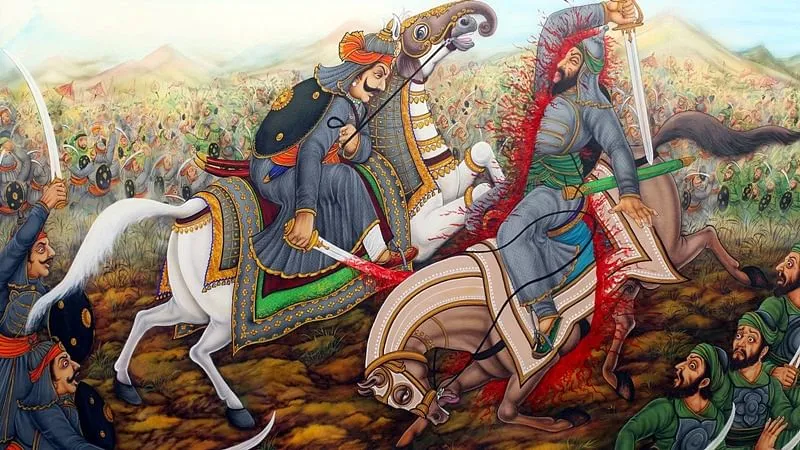
Irrespective the truness of the legend and despite the indecisiveness of the battle, it was the most impactful to both sides. It brought a dramatic change in the life of Maharana Pratap and the history of Mewar.
7. Love for Animals
Maharana Pratap was not just loyal to his motherliand or his people. He was a symbol of love and care to everything that belonged to his motherland.
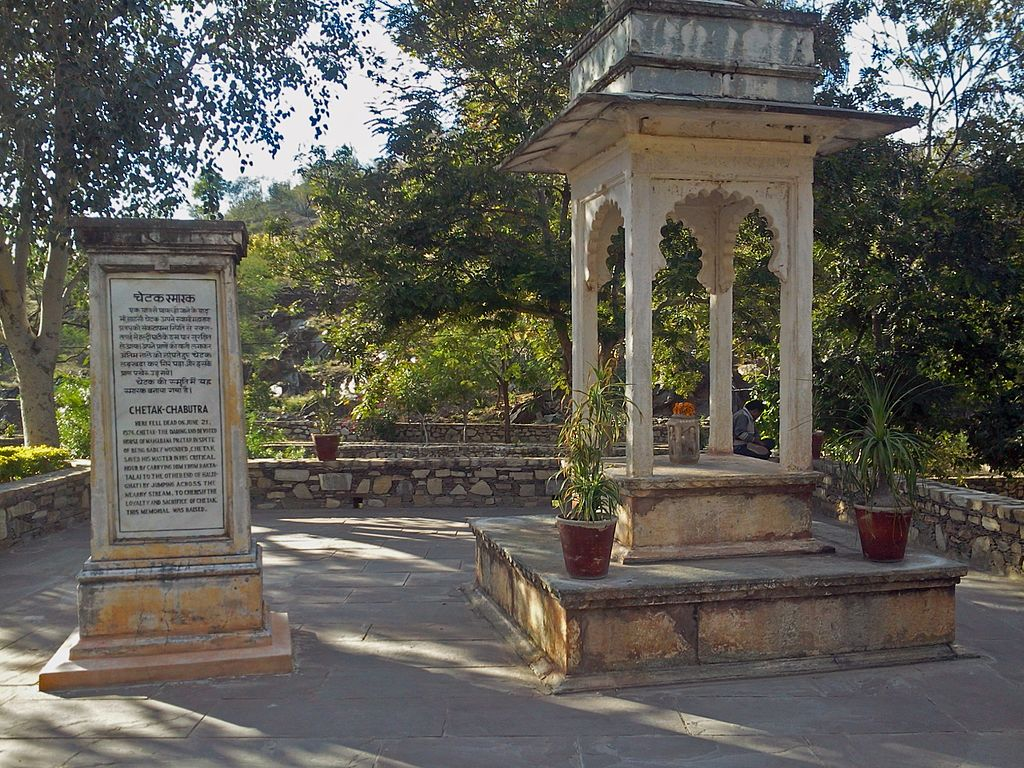
The legends of Chetak and his loyalty with Maharana Pratap indicate the love and care he received from Maharana. Chetak, the favourite horse of Maharana Pratap, was instrumental at the battle of Haldighati. He was badly injured. But did not leave Maharana Pratap during his cricis situations. He rescued half-conscious Maharana Pratap from the battlefield, crossed the river, took him at the safer side. This again shows animals never betray when they get true love and care. Maharana Pratap built the Chetak Smarak (memorial) at Balicha, the village he died. Archaeological Survey of India have declared the memorial as a monument of national importance.
The legend of Ramprasad is equally indicative to love and care of Maharana Pratap for animals. Ramprasad was an elephant, a trained co-warrior of Maharana Pratap. History remembers his bravery and contributions at the battle of Haldighati. But unfortunately, the Mughal army captured him. He was taken to Agra. Badshah Akbar tried to give him best treatments. But Ram Prasad had learnt his loyalty from the land of Mewar. He refused every single Mughal food and drink on offer. The brave elephant starved and survived for 18 days, till he took his last breath.
8. Establishing New Capital at Chawand
The Battle of Haldighati was a major loss of resoruces to Maharana Pratap. He had to retreat further southwards. But Maharana was relentless to reclaim his lost territories. In 1585 CE, Maharana Pratap captured Chawand from the Rathors. The location of Chawand was critical, since Udaipur was just 65 kilometers to the north. Chawand thus has a close attachment with Maharana Pratap and his life history. It became his military base and new capital.
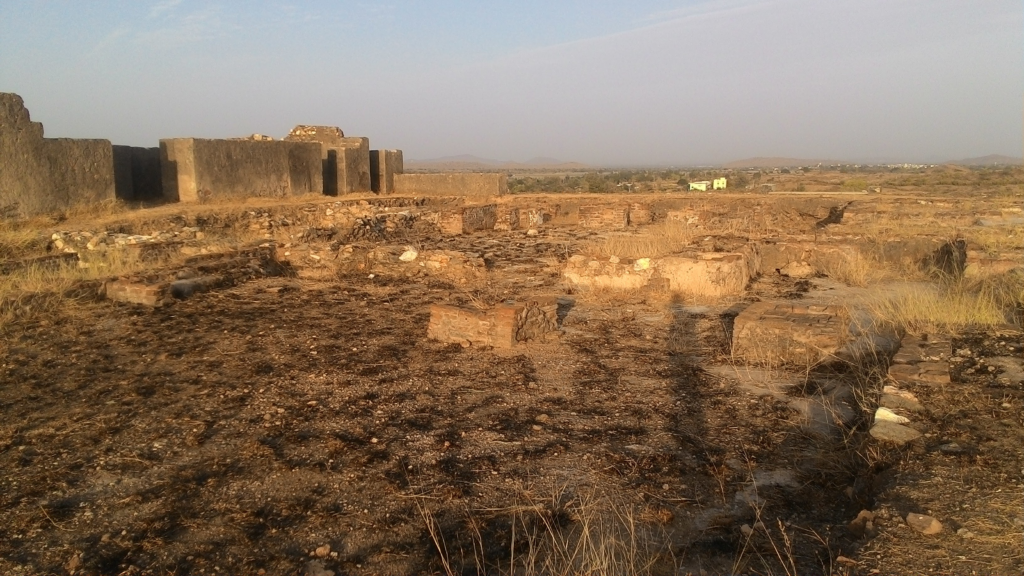
Chawand thus got a great historical significance. Maharana Pratap spent his last 12 years at Chawand. The town thus could witness his last few fights for his motherland. Maharana Pratap took his last breath at his palace of Chawand. Unfortunately, nobody cared to protect the heritage of Maharana Pratap and Chawand. The palace of Maharana Pratap, the last house of India’s first freedom fighter, now collapsed to ruins.
9. Faith and Support of the Bhils
Maharapa Pratap survived the battle of Haldighati with 7,000 soldiers only. Regions like Kumbhalgarh, Gogunda, Mandalgarh and central Mewar went under Mughal control. He knew the Bhils, the largest tribe of Mewar, were excellent in archery. They also possessed deep knowledge of terrains and densely forest of Aravalli. So, he invited the Bhils to join his army and shared the common goals of independence. On the other side, the Bhils had witnessed the relentless fight of Maharana very closely. Hence they a great faith in Maharana’s ability and will.
The relationship of Maharana Pratap with the Bhils of Aravalli again signify his greatness. Punja Bhil, the commander of Maharana Pratap, consolidated Bhil community to support him. The Bhils played crucial role intelligence gathering too. They supported Maharana Pratap to defend several Mughal campaigns.
10. Tactical Guerrilla Warfare
The tactical guerrilla warfare of Maharana Pratap applied a massive psychological pressure on Akbar. Mighty Mughal cannons were left useless to counter such attacks. It eventually frustrated Akbar. He slowly started losing focus on Mewar. Maharana Pratap, at the same time, kept rebuilding his army. It proved crucial to prepare for his major strike, at the Battle of Dewair. The battle earned him about 36 Mughal posts under control.
Badshah Akbar’s modern canons and artillery had thrashed his military resourses. But they couldn’t even touch the strong will power of Maharana Pratap. He adopted the famous guerrila war tactics and kept launching surprise attacks on Mughal troops and camps. The hide and strike strategy proved quited effective for Maharana. His men would launch surprise attacks, plunder Mughal troops and hide quickly into rugged terrain of Aravalli. Such tactical warfare resisted the Mughals take full control over the Kingdom of Mewar.
11. In-house Canon Forging
The warrior king knew that archers cavalry and archers can’t face Mughal cannons. So, he needed artillery power to win larger battles. But importing cannons were both expensive and time-consuming. Alternatively, in-house forging of cannons will take less time and cost-effective. He quickly fortified his stronghold positions with these self-built cannons. It boosted the morale of his army by several times.
Maharana Pratap’s self-made cannons were placed at his temporary capital Chawand. The smaller, light weight cannons were more suitable for mountain warfare. They proved more effective than the heavier Mughal cannons too. Smaller cannons fitted well in the rugged terrains of Aravalli hills. It produced great results at the battle of Dewair too.
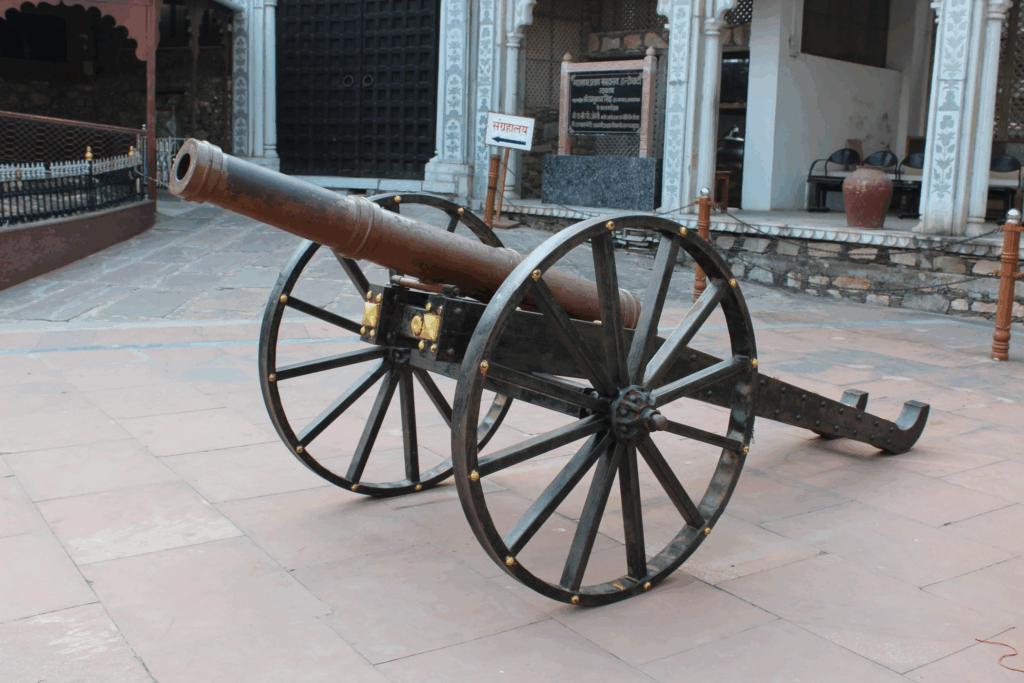
The home-made connons of Maharana Pratap marks his efforts towards self-sutainability. His self-reliance, ‘Swadeshi’ attitude was later idiolized during Indian national freedom movements.
12. Reclaiming Mughal Occupied Areas of Mewar
Maharana Pratap was a genious in tactical warfare. He was invincible in the hills of Aravalli. Between 1577 and 1580, Mughal commander Shabaz Khan Komboh led multiple campaigns in Mewar. But his tactical and calculated moves slowed down Mughal consolidation in the region. These six years, he also focused to rebuild his army and prepare for larger battles.
After 1579, Badshah Akbar’s focus shifted to the rebellions of Bengal and Bihar. In 1582, Maharana Pratap launched the campaign of Dewair. The decisive victory at the battle of Dewair led a comprehensive surrender of 36,000 Mughal soldiers. Also, 36 Mughal checkposts in Mughal occupied Mewar came under Maharana’s control.
In 1584, Badshah Akbar led another campaign of Mewar. More than 100,000 Mughal army was led by Mughal chieftains Jagannath Kachhawah and Man Singh. In fact, Akbar himself arrived in Mewar. The Mughal army tried everyhting possible to capture Maharana Pratap. After six months, dejected Akbar returned to Agra. In 1585, he moved to Lahore to handle the incursion of Mirza Hakim, his step brother.
Maharana Pratap reclaimed many of his lost territories from the periods between 1585 and his death. But unfortunately, reclaim of Chittor remained a major pain of the great patriot.
13. Patron of Art and Culture
Maharana Pratap was a great patron of art and music too. Even during his difficult times, he encouraged preservation of Mewar’s art and culture. Chawand, his temporary capital, became a center of art and culture. Maharana Pratap provided shelters to many poets, writers and artisans in his court an Chawand. Not only that, Chawand school of art was built and developed under patronage of Maharana Pratap. Ustad Nasiruddin was among the key notable figures in his court.
14. Made Badshah Akbar Mourne
Maharana Pratap sustained a deep wound from hunting. The infection truned more critical with time and kept deteriorating his health. Maharana Pratap eventually died on 19th January, 1597, at his palace of Chawand.
Several historical accounts described that the death of Maharana Pratap deeply saddened Badshah Akbar. The greatness of Maharana Pratap was highly admired in Akbar’s court.
Legacy of Maharana Pratap Singh
The life story of Maharana Pratap Singh is a true inspiration for billions of Indian hearts. His uncompromising principles, aggression in the battlefield, loyalty to motherland and love and care for his people and animals were matchless. The guerrila war tactics of Maharana Pratap greatly influenced the revolutionarists during the Indian freedom movements. His attitude to rebuild his army to win major battles later idiolized by Indian nationlists.
Maharana Pratap is also symbolized for his self-sustainble approaches. Today’s Swadeshi or indegenious or make in India thinking is somehow linked to Maharana Pratap and his phylosophies. His pets even sacrifised their lives to protect him or refused to live without him. His death made his greatest rival mourne. He lived most of his life in exile but patroned art and culture, refuged poets, artists and artisans in his court. All these legacies are very rare in any single Indian individuals. Maharana Pratap thus will continue to live in Indian hearts forever.

Pingback: History of Kumbhalgarh fort in Rajasthan - History Finder
Pingback: Jalaluddin Akbar history and his military conquests - History Finder
Pingback: Chittor Fort history of siege and jauhars - History Finder
Pingback: Rajput Kingdoms: History, Culture, Dynasties and Their Legacy - History Finder