The history of the Vijayanagara Empire stands as one of the most dramatic and transformative chapters of medieval India. In the early 14th century, South India witnessed severe political collapse and cultural disruption following repeated invasions from the north. The region urgently needed a strong power to restore stability, revive declining traditions, and protect its regional identity. The birth of the Vijayanagara Empire answered this need, marking not only a response to crisis but also the rise of one of the wealthiest and most influential empires of the medieval world.
Today, Vijayanagara is a district in the Indian state of Karnataka, housing the ruins of the empire’s former capital, Hampi. Recognized by UNESCO as a World Heritage Site, Hampi stands as enduring evidence of the empire’s historical significance and architectural grandeur.
But how did it all begin? Who were the visionaries behind this remarkable revival? And why did Hampi, a rugged landscape of hills and boulders, become the beating heart of a powerful empire?
Let us uncover the true history behind the birth of Vijayanagara Empire.
Before the Birth of Vijayanagara Empire: Background History
The 13th and early 14th centuries marked one of the most turbulent periods in the history of South India. Repeated military expeditions launched by the Delhi Sultanate severely destabilized the region, weakening established kingdoms and disrupting long-standing political and economic systems. The once-powerful Yadavas of Devagiri, Kakatiyas of Warangal, and Pandyas of Madurai suffered decisive defeats, leading to their eventual collapse. Smaller states such as Kampili emerged briefly, but failed to survive sustained attacks.
Under rulers like Alauddin Khilji and later Muhammad bin Tughlaq, the northern campaigns aimed at territorial control and revenue extraction caused widespread damage. Temples, royal centers, and educational institutions were destroyed, while urban economies and administrative structures disintegrated. These invasions did not merely affect political authority; they deeply disrupted the social and cultural fabric of South India.
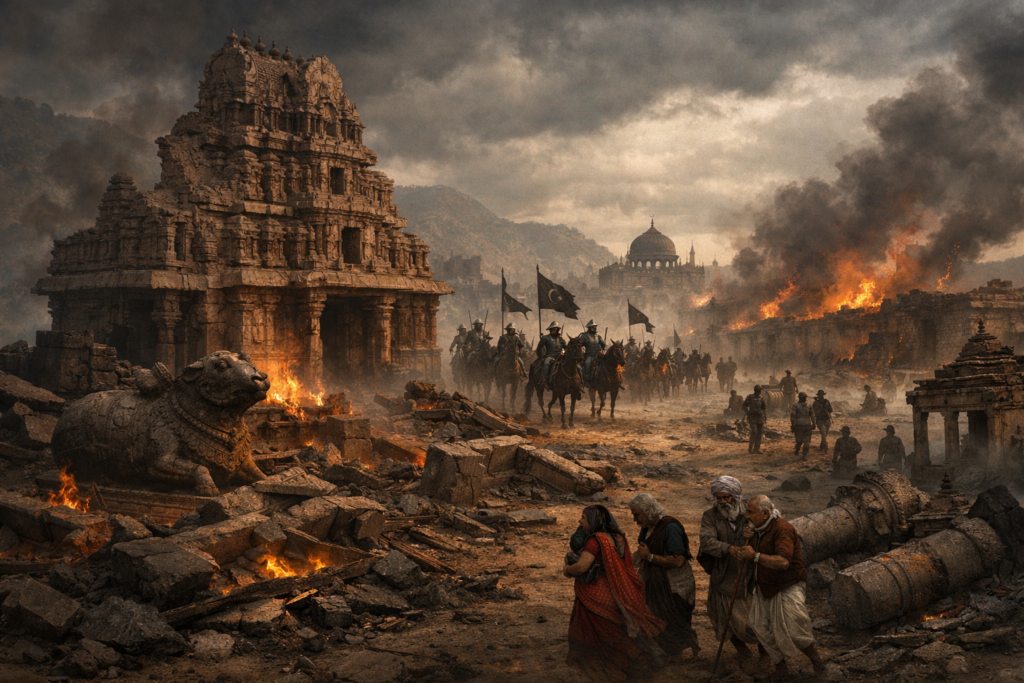
The devastating expeditions led by Malik Kafur (1310–1311) and the subsequent campaigns of Muhammad bin Tughlaq in the 1320s proved particularly destructive. Agricultural systems collapsed, trade routes were disrupted, and prolonged instability forced artisans, scholars, and merchants to migrate in large numbers, draining the region of skilled human resources.
The fall of Warangal in 1323 and the weakening of the Pandyan kingdom led to the establishment of the Madurai Sultanate. However, its policies failed to restore stability and instead intensified economic and social unrest across the Tamil region.
By the early 14th century, South India urgently required a new political power—one capable of resisting northern expansion, restoring order, and reviving cultural confidence. This historical crisis created the conditions that directly led to the rise of the Vijayanagara Empire.
Who were Hakka and Bukka Raya?
Harihara I (also known as Hakka) and Bukka Raya I were the founders of the Vijayanagara Empire and among the most influential figures in the history of South India. The two brothers restored order, when the region was facing severe political instability and economic decline. In the process, they protected cultural traditions, and revived regional confidence.
Both rulers belonged to the Sangama dynasty, the first ruling house of Vijayanagara. Later inscriptions issued during the reign of Harihara II suggest a possible ancestral link to the Yadavas of Devagiri. Essentially, the inscriptions also identify the family with the Chandravamsa Kshatriya lineage. While historians continue to debate these dynastic claims, there is no dispute regarding the decisive role played by Harihara and Bukka in reshaping South Indian history through the establishment of the Vijayanagara Empire.
Scholarly opinion also differs regarding their regional origins. Many historians identify Harihara and Bukka as Kannadigas, based on inscriptional and geographical evidence, while an alternative view suggests Telugu origins. This debate reflects the multicultural and multilingual nature of the Deccan during the 14th century rather than diminishing their historical importance.
Historical Facts About Their Early Life
The birth of the Vijayanagara Empire is closely connected to the early careers of Harihara and Bukka. According to the local legends, before founding their own kingdom, the brothers had served as senior military commanders or administrators under the Kakatiya ruler Prataparudra II of Warangal. Their service under an established Deccan power provided them with valuable experience in governance, warfare, and regional politics.
The situation changed dramatically following the invasion of Malik Kafur, acting on behalf of the Delhi Sultanate. The fall of Warangal in 1323 marked the end of Kakatiya independence. In the aftermath, Harihara and Bukka sought refuge in the small kingdom of Kampili. But Kampili too fell to Muhammad bin Tughlaq. The Sangama brothers were captured and taken to Delhi.
According to the later inscriptions, the brothers were compelled to convert to Islam during their captivity. Few other accounts further suggest that upon their return to South India, they reconverted to Hinduism, after they met with Sage Vidyaranya. However, modern historians approach these narratives with caution, viewing them as either symbolic or partially exaggerated. Regardless of their exact historical accuracy, these traditions highlight the resilience, adaptability, and political awareness of Harihara and Bukka—qualities that would later define their success as founders of Vijayanagara.
The Guiding Force Behind the Revival
Just as birth of the Mauryan Empire relied on Chanakya for guidance, the birth of the Vijayanagara Empire was never possible without Sage Vidyaranya. He was a distinguished scholar of the Sringeri Sharada Peetham. His intellectual and spiritual leadership played a decisive role in shaping the vision behind the empire’s birth.
The northern invasions did not merely weaken South India politically or economically; they deeply unsettled its social, cultural, and religious foundations. As a result, any lasting revival required more than military resistance—it demanded the restoration of cultural confidence and moral legitimacy. This is where Vidyaranya’s influence became crucial.
Sage Vidyaranya was not simply a spiritual mentor. He emerged as the intellectual force behind the founding of the Vijayanagara Empire. Following their return from Delhi, Harihara and Bukka are believed to have received his guidance in matters of governance, legitimacy, and statecraft. Under his influence, the early Vijayanagara rulers reorganized temple patronage, supported traditional learning, and presented their kingdom as a defender of regional traditions in a period of deep uncertainty.
Vidyaranya’s contribution extended beyond politics. As the author of influential philosophical works such as Panchadashi, he played a major role in reviving Advaita Vedanta and Sanskrit scholarship. His intellectual authority helped transform Vijayanagara into not just a political power, but a cultural center that restored confidence among scholars, priests, and common people alike.
The ideological direction of Sage Vidyaranya ensured the right foundations for the empire—a balance of power and principle. The early success of the Vijayanagara Empire was therefore shaped at its very birth, through the military prowess of its rulers guided by intellectual and spiritual wisdom.
Birth of Vijayanagara Empire: Early Days
The birth of the Vijayanagara Empire was rooted in a determined effort to reclaim political stability in South India after decades of turmoil. By 1336 CE, Harihara I, along with his brother Bukka Raya I, had successfully established control over the region south of the Tungabhadra River, which had remained vulnerable following repeated northern invasions. Contemporary inscriptions and later historical traditions recognize this moment as the formal foundation of the Vijayanagara state.
Harihara I soon assumed the royal epithet “Purvapaschima Samudradhishavara”—the lord of the eastern and western seas. While this title symbolized imperial ambition rather than actual maritime control at this early stage, it reflected the rulers’ vision of a sovereign and expansive polity. Initially, however, Vijayanagara functioned more as a protectorate, safeguarding regional interests rather than asserting full imperial authority. Yet, South Indian history regards this phase as the true foundation upon which one of the subcontinent’s greatest empires would rise.
Administrative Changes
After establishing the capital region around Anegundi–Hampi, Harihara I focused on consolidating power through administrative organization. Recognizing that military strength alone was insufficient, he laid the groundwork for governance by introducing the Nayankara system. Under this arrangement, land grants were assigned to military chiefs (nayakas) in return for military service during times of war. This system not only strengthened the army but also ensured local stability and revenue collection—an administrative model that would later define Vijayanagara governance.
Alliances
Harihara I also understood the importance of alliances. It was obvious that his forces alone could not resist all external threats. Consequently, he formed strategic partnerships with regional chieftains, including the remnants of the Hoysala leadership, thereby creating a broad coalition against northern pressures.
Meanwhile, the harsh rule of the Madurai Sultanate had destabilized large parts of the Tamil region. Harihara I actively sought to push the Sultanate further south, restoring order and justice in reclaimed territories. Through these territorial expansions, administrative reforms, and alliances, Vijayanagara rapidly evolved from a regional protectorate into a recognized imperial power.
Following Harihara I’s death, Bukka Raya I ascended the throne around 1374 CE and further consolidated the empire. The Reddys of Kondavidu, the chiefs of Arcot, and eventually the Sultan of Madurai acknowledged Vijayanagara’s dominance. Inscriptions from Bukka’s reign attest to expanded territorial control and strengthened administration. During this period, the capital was gradually shifted from Anegundi to Hampi, which would later emerge as the magnificent imperial center of the Vijayanagara Empire.
Key Administrative and Military Achievements
- Introducing the Nayankara system in administration.
- Strengthened irrigation through tanks and canals to boost agriculture.
- Reorganized temple lands to revive economic activity.
- Formed alliances with surviving Hoysala and regional leaders.
- Pushed back against the Madurai Sultanate.
Inscriptional evidences show several donations to temples like Srisailam, Tiruvannamalai, and Hampi—symbolic to reviving the old cultural order.
Within a generation, the empire transformed into a powerful bulwark against northern invasions.
Why Hampi Was Chosen as Capital?
The birth history of Vijayanagara Empire is incomplete without the foundation of Hampi as the capital of the gigantic kingdom. Historical sources and modern archaeology both reveal why Hampi became the perfect capital of Vijayanagara Empire.
Natural defense and strategic location were the crucial factors and priorities for Harihara I, who chose Hampi as the capital of Vijayanagara Empire. But at the same time, the king had to consider the economic, religious and cultural growth potentials as well.
Strategic Advantages of Hampi as Capital of Vijayanagara
- Naturally fortified by massive granite boulders.
- Surrounded by hills forming a defensive ring.
- Tungabhadra River protected the northern flank.
- Fertile plains ideal for rice, sugarcane, and areca nut.
- Located near ancient trade routes connecting the Deccan to the western coast.
- Presence of the ancient Virupaksha Temple, making the region spiritually significant.
In short, the founders didn’t just choose a capital. They chose a place that as a symbol of cultural renewal and divine protection.
Vijayanagara Empire Beyond India
The birth of the Vijayanagara Empire in 1336 shaped South Indian history for nearly three centuries. From its foundation, however, the empire was not an isolated inland power. The selection of Hampi, on the banks of the Tungabhadra River, ensured early economic and diplomatic links with the wider medieval world.
Within a few decades, Vijayanagara became an active participant in international trade networks. Foreign merchants and travelers noted the empire’s wealth, urban order, and commercial activity. These developments were rooted in the founders’ strategic vision, which combined territorial defense with control over trade routes.

Hampi was connected to key ports such as Bhatkal, Honavar, Goa, and Machilipatnam through established riverine and overland routes. These ports linked the empire to the Persian Gulf, Arabia, Southeast Asia, China, and Europe. Through this network, Vijayanagara exported diamonds, spices, cotton textiles, rice, and sugar, while importing Arabian and Persian horses, essential for its cavalry.
The empire’s global reach was therefore not accidental. It was embedded in the foundations laid in 1336. By choosing Hampi as its capital, Vijayanagara secured access to the ancient trade routes connecting the Deccan plateau with both the Arabian Sea and the Bay of Bengal. From its birth, the empire emerged not only as a defensive power, but also as a gateway between inland India and the wider medieval world.
What Foreigners Had to Say About Vijayanagara?
Foreign traders and travelers consistently viewed Vijayanagara as a rising power in the Deccan. From its early years, the empire drew attention for its economic strength and military presence. Economically, Vijayanagara ranked among the wealthiest empires of medieval India and the wider world.
Travelers such as Abdur Razzaq, Niccolò de’ Conti, and Domingo Paes left vivid accounts of Hampi, the imperial capital. They described vast markets, well-planned streets, grand temples, and immense wealth. Precious stones, spices, textiles, and daily goods were available in abundance. Many observers also noted the prosperity visible among merchants and ordinary people.
The reputation of Vijayanagara appeared in foreign travel accounts well before its golden age. Persian chroniclers first recorded its growing power, followed later by European travelers arriving through maritime trade routes. Abdur Razzaq, who visited in the mid-15th century, described Vijayanagara as one of the largest and most impressive cities he had seen. Domingo Paes, writing during the reign of Krishnadevaraya, provided detailed observations of markets, festivals, and royal ceremonies.
Together, these accounts show that Vijayanagara’s international reputation was built on foundations laid soon after its birth. Foreign admiration was directed not only at wealth, but also at the empire’s organization and stability. These travel narratives remain invaluable sources for understanding why Vijayanagara was regarded as a major power of the medieval world.
Cultural Vision with Global Implications
The political collapse of South India in the medieval period was accompanied by a deep cultural disruption. In contrast, the Vijayanagara Empire pursued a deliberate policy of cultural revival, protection, and promotion. From its earliest years, the empire sought to restore confidence in religious, educational, and artistic life across the region.
Vijayanagara rulers actively restored temples, revitalizing religious institutions that had fallen into decline. At the same time, they supported centers of learning and encouraged intellectual activity across languages and traditions. Sanskrit and Dravidian languages both received royal patronage, allowing multiple cultural streams to flourish together. As a result, Vijayanagara emerged as a powerful cultural center of South India.
Within a few decades, traditions inherited from the Cholas, Hoysalas, Pandyas, and Chalukyas blended into a distinct imperial culture. This synthesis attracted scholars, artisans, architects, musicians, and performers from across regions. The capital and its surrounding areas developed into a cosmopolitan environment, where regional traditions coexisted within a shared imperial identity.
This early cultural confidence played a crucial role in shaping Vijayanagara’s global image. Foreign visitors encountered not only wealth and military strength, but also a vibrant, orderly, and culturally rich civilization. The empire’s reputation abroad was therefore grounded in cultural foundations laid close to its birth.
Conclusion
The history of the Vijayanagara Empire’s birth is a powerful story of resilience and revival. At a time of political collapse and cultural uncertainty, Harihara I and Bukka Raya I restored stability, confidence, and prosperity to South India. For this reason, historians regard the Vijayanagara Empire as one of the most significant political and cultural formations in South Indian history.
By choosing Hampi as their capital and introducing effective administrative and military systems, the founders laid the foundations of an empire that endured for more than three centuries. These early decisions shaped not only territorial expansion, but also economic strength, cultural confidence, and global engagement.
The rise of Vijayanagara was therefore more than the birth of a new kingdom. It marked the rebirth of a civilization, rooted in its past yet firmly connected to the wider medieval world.
Frequently Asked Questions
The Vijayanagara Empire was founded in 1336 CE by Harihara I and Bukka Raya I on the banks of the Tungabhadra River, with Hampi as its capital.
Hampi was chosen due to its natural defenses, fertile river plains, access to ancient trade routes, and the presence of the sacred Virupaksha Temple, which gave the capital both strategic and spiritual significance.
The founders were guided by Sage Vidyaranya, a scholar of the Sringeri Sharada Peetham, who provided intellectual and spiritual direction during the empire’s early formation.
Foreign trade was crucial from the empire’s birth. Vijayanagara exported spices, diamonds, textiles, rice, and sugar, while importing Arabian and Persian horses, linking the empire to global trade networks.
Foreign travelers such as Abdur Razzaq, Niccolò de’ Conti, and Domingo Paes recorded detailed descriptions of Vijayanagara’s wealth, markets, temples, and urban life.
The empire restored temples, supported education, patronized Sanskrit and Dravidian languages, and blended earlier traditions from the Cholas, Hoysalas, Pandyas, and Chalukyas into a unified imperial culture.
The Vijayanagara Empire is significant for restoring political stability to South India, promoting cultural revival, sustaining global trade, and emerging as one of the most powerful medieval empires in the Indian subcontinent.
You May Also Like:
Rani Didda of Kashmir: Power, Politics, and Legacy of a Forgotten Queen
Harshnath Temple, Sikar: The Forgotten Shiva Shrine of Rajasthan
Nalanda University History – The Lost Intellectual Capital of Asia
Historical Value of the Rig Veda as a Source of Early Indian History
History of Delhi: Rise, Destruction, and Rebirth of India’s Eternal Capital
Establishment of the Delhi Sultanate: How a New Era Began in India
The Making of Raigad: The Capital of Chhatrapati Shivaji Maharaj
Rajput Kingdoms: History, Culture, Dynasties and Their Legacy
History of the Maratha Empire: Rise, Expansion, and Fall of a Powerful Confederacy
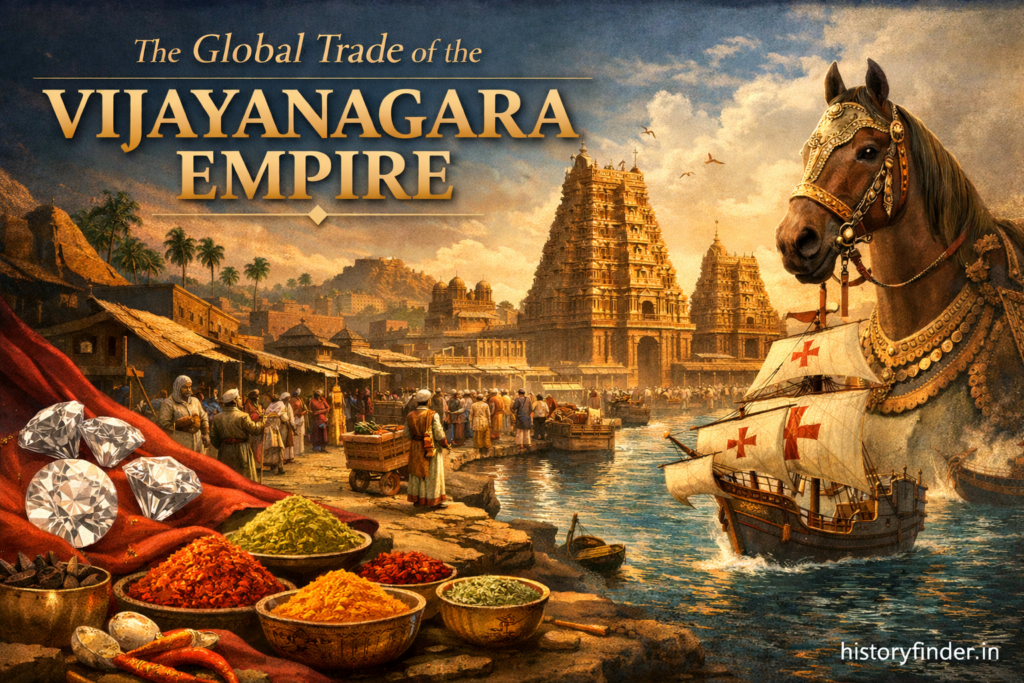
Diamonds, Spices, and Horses: Global Trade of The Vijayanagara Empire
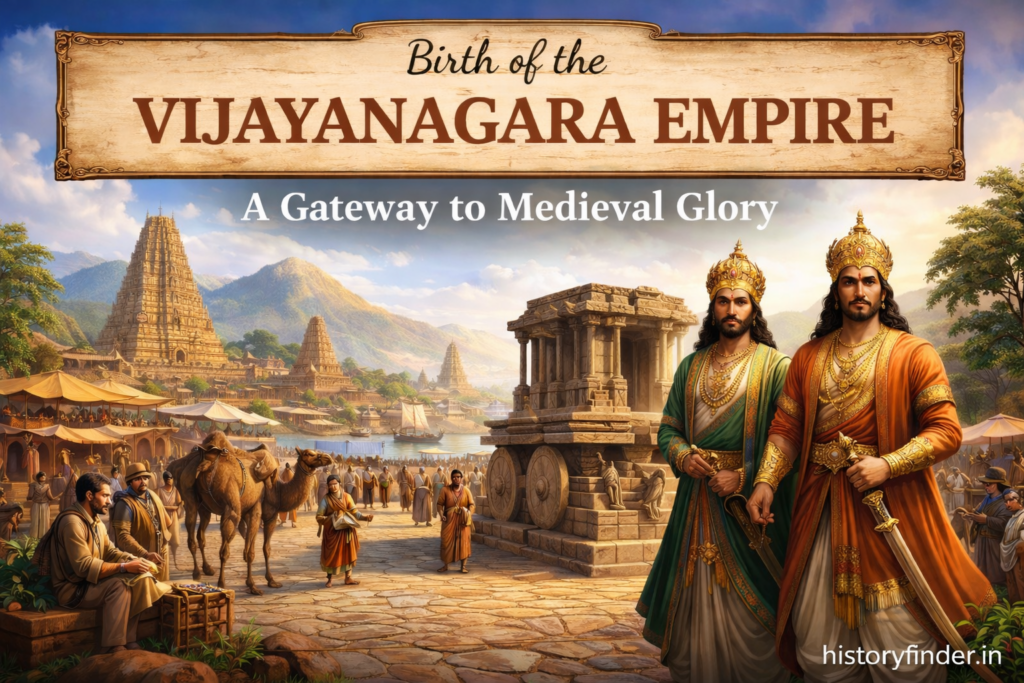
How Vijayanagara Empire Was Born: History of A Grand Revival