
Across India, many ancient temples stand quietly beyond the attention of major pilgrimage routes. Some once flourished as important religious centers. Yet over time, they gradually faded from wider public memory. The Harshnath Temple history begins with one such remarkable shrine located near Sikar in Rajasthan.
Perched on the slopes of Harsha Hill, the temple dedicated to Shiva overlooks the surrounding landscape of the Shekhawati region. Today, the surviving ruins appear calm and almost isolated. However, these stones once formed part of a far more vibrant religious complex that attracted devotees, rulers, and craftsmen.
At first glance, Harshnath Temple may seem like just another medieval shrine scattered across the hills of Rajasthan. Yet its location, architectural fragments, and historical inscriptions reveal a deeper story. They hint at a period when temple building flourished across northern India and regional dynasties invested heavily in sacred monuments.
This raises several intriguing questions. Who commissioned this temple on a remote hilltop? Why was this particular site chosen for a shrine of such importance? And how did a once-prominent Shaiva center gradually slip into relative obscurity?
Exploring the Harshnath Temple history therefore becomes more than simply tracing the story of a temple. It opens a window into the religious landscape of early medieval Rajasthan, where politics, devotion, and artistic ambition often converged in stone.
Historical Origins of Harshnath Temple
Understanding the Harshnath Temple history requires looking closely at the historical evidence preserved at the site. A surviving inscription on Harsha Hill provides an important clue about the temple origin.
The inscription, dated to 973 CE, records that the temple was built during the reign of the Simharaja, a powerful ruler of the Chahamana dynasty. This dynasty—often identified with the later Chauhans. They controlled large parts of present-day Rajasthan during the early medieval period. Temple construction became an important expression of political authority and religious devotion during the age.
For medieval Indian rulers, temples served as symbols of legitimacy, cultural prestige, and royal patronage. By sponsoring grand religious monuments, kings demonstrated both their devotion to the gods and their role as protectors of dharma.
In this context, the construction of Harshnath Temple appears to reflect a deliberate royal initiative. The temple was dedicated to Shiva, one of the most widely worshipped deities in Rajasthan. Shaivism enjoyed strong patronage from several regional dynasties, and the Chahamanas were no exception.
Yet historians continue to examine an important question: why was this temple built on a hilltop?
Some scholars suggest that elevated locations were obvious choice for symbolic reasons. Hilltop temples didn’t only enhance its visual prominence but also reinforce the sacred geography of the region. Pilgrims approaching the shrine could see the temple from a distance, creating a powerful spiritual impression among the devotees.
Hilltop location also have reflected older local traditions. Sacred hills often reflect divine presence in Indian religious culture, making them ideal sites for major temples. Therefore, the Harshnath Temple history reflects a combination of political ambition, religious devotion, and landscape symbolism.
Architecture of Harshnath Temple: What the Ruins Reveal
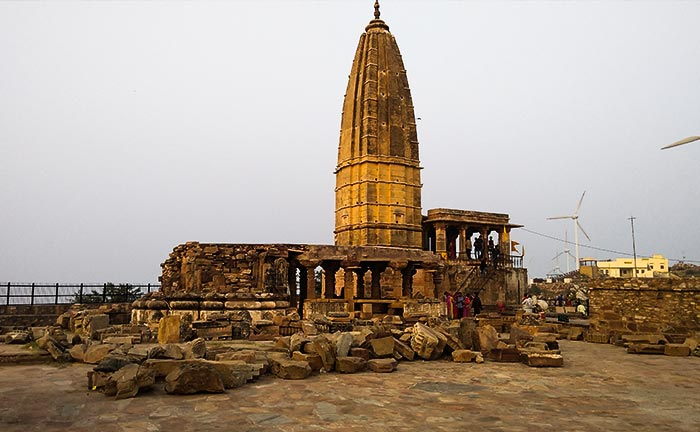
The architectural remains of Harshnath Temple provide important evidence about temple construction in early medieval northern India. Although the structure now survives only in partial ruins, the remaining foundations, pillars, and sculptural fragments allow historians to reconstruct many aspects of the original design. These architectural features also reflect the broader temple-building traditions that developed during the rule of the Chahamana dynasty in the 10th century.
Temple Layout and Structural Design
The overall layout of the temple follows the conventions of Nagara architecture, which was widely used across northern and western India during this period. Temples built in this style typically consist of a sanctum (garbhagriha), a pillared hall (mandapa), and a superstructure (shikhara) rising above the sanctum.
Archaeological remains at the site indicate that the temple originally included:
- A garbhagriha, the inner chamber where the principal deity was installed.
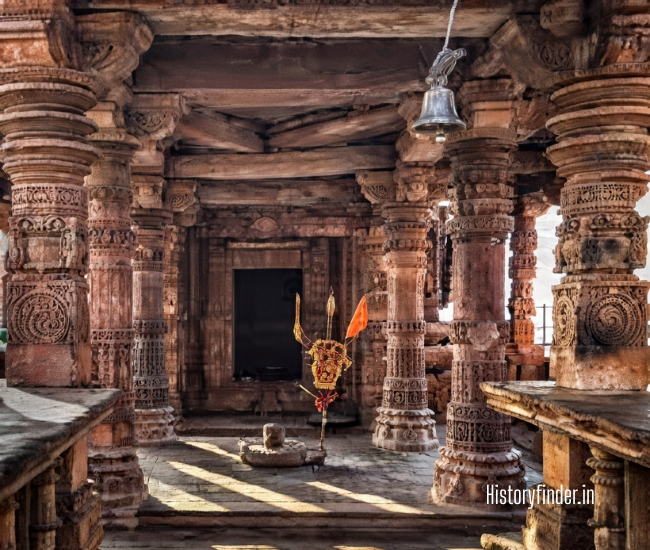
- A mandapa, supported by carved pillars that provided space for congregational worship
- An elevated platform, which raised the temple above the surrounding terrain
Although the original shikhara has largely collapsed, surviving architectural fragments suggest that it once formed a prominent vertical element typical of Nagara temples. The hilltop location on Harsha Hill would have further increased the visual prominence of the structure.
Sculptural Art and Iconography of Harshnath Temple
Several sculptural fragments found around the temple site demonstrate the high level of craftsmanship achieved by artisans of the period. These carvings were originally placed along the outer walls, doorframes, and pillars of the temple.
The sculptural themes include:
- Representations of Shiva in various iconographic forms;
- Figures of divine attendants and celestial beings;
- Decorative patterns consisting of floral and geometric motifs;
- Symbolic animals and mythological figures.
The doorframes of many medieval temples were particularly elaborate, and fragments from Harshnath Temple suggest a similar tradition. Multi-layered carvings and ornamental bands emphasize the sacred entrance leading to the sanctum.
Art historians have noted that such sculptural style corresponds with artistic trends in other early medieval temples of Rajasthan. These works demonstrate both detailed carving techniques, typical of the region’s temple sculptures during the 10th and 11th centuries.
Evidence of a Larger Temple Complex
Archaeological observations indicate that the main shrine was likely part of a larger religious complex. The presence of scattered foundations and structural fragments suggests that several smaller shrines once surrounded the principal temple.
Such temple clusters were common in early medieval India. Secondary shrines were often dedicated to associated deities or different manifestations of the primary god worshipped in the main temple. In the case of Harshnath, these subsidiary structures may connect with the wider Shaiva religious tradition.
The remains also indicate the presence of additional architectural elements such as pillared structures and boundary walls, which would have defined the sacred precinct of the temple complex.
Architectural Evidence and Historical Interpretation
For historians, the architectural remains of Harshnath Temple provide valuable information about the cultural and economic conditions of the period. The scale of the temple and the quality of the sculptural work suggest that its construction required considerable resources, skilled artisans, and organized patronage.
These characteristics align with the historical context of the Chahamana dynasty, which supported temple building as part of its broader political and religious policies. As a result, the architectural remains of the temple contribute significantly in understanding the development of temple architecture and religious institutions in early medieval Rajasthan.
Religious Significance of Harshnath Temple
The understanding of Harshnath Temple history is not complete without examining its religious context. Lord Shiva, the principal deity, is also one of the most influential deities in medieval Indian religious traditions. During the early medieval period, Shaivism spread widely across northern and western India, supported by both royal patronage and established pilgrimage networks. In this context, the location and dedication of Harshnath Temple suggest that the site once held notable religious importance in the region around Sikar.
Shaivism in Early Medieval Rajasthan
During the 9th–11th centuries, Shaivism emerged as a dominant religious tradition across large parts of Rajasthan. Several ruling dynasties patronized temples dedicated to Shiva, which often functioned as both religious and socio-economic institutions.
Historians studying temple inscriptions and architectural remains have observed that Shaiva temples frequently served as focal points for local communities. They hosted religious rituals, supported priestly groups, and sometimes controlled land grants associated with temple maintenance.
The construction of a major Shiva temple under the Chahamana dynasty indicates that Shaivism was not only a devotional practice. But also part of a broader political and cultural framework. By sponsoring temples, rulers reinforced their legitimacy and strengthened ties with religious institutions.
Meaning and Interpretation of the Name “Harshnath”
The name “Harshnath” itself carries religious significance. The term arrived from “Harsha”, which refers to the hill on which the temple stands. Also the term “Nath”, a title commonly associates with Shiva as the supreme lord among the Hindu Trinity.
Therefore, Harshnath can be interpreted as “Lord of Harsha Hill.” This naming pattern is consistent with many temple traditions in India. In most cases, the deity has close association with a specific geographic location.
The naming convention reflects the concept of sacred geography, where natural landscapes such as hills, rivers, and forests become integrated into religious worship. In such cases, the physical environment itself acquires symbolic meaning within the religious tradition.
Hilltop Temples and Sacred Geography
The placement of Harshnath Temple on Harsha Hill is also significant from a religious perspective. In many parts of India, elevated landscapes would traditionally represent the sacred presence of spiritual power.
Temples constructed on hills often served multiple purposes:
- They created a visually prominent religious landmark.
- They symbolized closeness to the divine realm.
- They encouraged pilgrimage journeys that involved physical ascent.
The location of the temple likely enhanced its religious importance by transforming the entire hill into a sacred space. Such spatial arrangements are common in medieval temple traditions, where the natural environment forms an integral part of the ritual landscape.
Historical Decline of the Harshnath Temple
Despite its early significance, the temple gradually declined over the centuries. Historical records indicate that later political conflicts in the region. As a result, many of the original structures destroyed, leaving behind only fragments of the once extensive temple complex.
The decline of the temple reflects broader historical processes. Changes in political power, shifting pilgrimage patterns, and the emergence of new religious centers often led to the gradual abandonment of older temple sites.
Today, however, the surviving remains of Harshnath Temple continue to provide valuable insights into the religious landscape of early medieval Rajasthan. It offers historians an important case study of how religion, geography, and political authority interacted in the formation of temple institutions.
Destruction and Decline of Harshnath Temple
The later history of Harshnath Temple reflects gradual decline and structural destruction. While the temple once functioned as an important Shaiva shrine, several historical developments over the following centuries altered its status. Archaeological remains and historical records together provide insight into how the temple complex was eventually reduced to ruins.
Evidence of Structural Damage
The current condition of the temple site indicates signs of deliberate destruction. Many architectural components—including pillars, sculptures, and other portions of the structure are found scattered across the hilltop. Many of structural parts lying down far from their original positions.
Scholars studying the remains have noted clear signs of structural dismantling rather than natural collapse. Broken sculptures, displaced stone blocks, and missing architectural sections suggest that the temple complex experienced organized destruction at some point in its later history.
Such patterns of damage are common at several medieval temple sites across northern India. In most cases, political conflicts and changes in ruling authority often affected religious monuments.
Historical Accounts of Destruction
Some historical traditions associate the destruction of the temple with the campaigns of Aurangzeb during the 17th century. According to regional accounts, the Mughal emperor issued orders were which led to the dismantling of several temples in parts of Rajasthan.
Although detailed contemporary documentation specifically describing the destruction of Harshnath Temple has limitations. Local historical narratives and later historical writings frequently connect the damage to policies implemented during the Mughal period.
Historians often approach such claims with caution. While destructio of some temples indeed occurred during political conflicts in the Mughal era. But each site requires careful evaluation of archaeological evidence, inscriptions, and historical sources before drawing definitive conclusions.
Political Changes and Religious Institutions
One must understand the decline of the Harshnath Temple within the broader political transformations that affected the region. Over time, the power of the Chahamana dynasty diminished, and new political authorities emerged across northern India.
When ruling dynasties change, the patterns of temple patronage often changes. Temples that once received royal support loses financial backing, administrative protection, or religious prominence.
The survival of medieval temples was closely linked to continued patronage. Without institutional support, even major religious sites could gradually fall into neglect or decay.
Fragmentation of the Temple Complex
Archaeological observations also indicate reusage of few parts of the original temple complex in later constructions. In several historical contexts, stones from damaged temples were reused in nearby constuctions.
This process of architectural demolition and reuse explains the current situation. Why many sculptural fragments from Harshnath Temple are found scattered around the site rather than preserved in complete structural form.
Harshnath Temple as an Archaeological Site Today
Today, the ruins of Harshnath Temple stand as an important historical and archaeological site in the region near Sikar. The surviving architectural fragments continue to provide scholars with valuable information about early medieval temple construction and regional artistic traditions.
Although much of the original complex has disappeared, the site remains a significant example of temple architecture associated with the Chahamana dynasty and the wider Shaiva religious landscape of medieval Rajasthan.
For historians and archaeologists, the ruins of Harshnath Temple represent not only the remains of a once prominent religious center but also an important source for studying the cultural and political transformations that shaped northern India over several centuries.
Harshnath Temple Today: Preservation and Historical Importance
Today, Harshnath Temple survives mainly as an archaeological site. Although much of the original complex is no longer intact, the remaining structures still provide valuable information about medieval temple architecture in northern India.
The temple ruins stand on Harsha Hill, about 14 km from Sikar in Rajasthan. The location continues to attract historians, archaeologists, and visitors interested in early medieval Indian temples.
Archaeological Protection and Site Management
The Archaeological Survey of India protects the temple complex. As a protected monument, the site is maintained to preserve the remaining architectural elements and sculptures.
Archaeological surveys at the site have documented the temple foundations, broken pillars and carved stones and the sculptural fragments from the original structure. These remains help researchers study construction methods and artistic traditions associated with the Chahamana dynasty.
Preserving damaged monuments is important because architectural fragments can still provide reliable historical evidence. Even partial remains allow scholars to reconstruct temple layouts, artistic styles, and cultural practices of earlier periods.
Continuing Religious Activity
Although much of the historical complex is in ruins, religious activity at the site has not completely disappeared. A small functioning shrine dedicated to Lord Shiva still exists near the remains of the old temple.
Local devotees continue to visit the hill for worship, especially during Mahashivaratri, an important festival dedicated to Shiva.
Historical Importance for Researchers
For historians and archaeologists, Harshnath Temple remains an important case study of early medieval temple construction in Rajasthan. The site contributes to several areas of historical research:
- Development of Nagara architecture
- Temple patronage under the Chahamana dynasty
- Sculptural traditions of medieval western India
- The role of hilltop temples in sacred geography
Sites like Harshnath Temple help historians understand how religion, politics, and architecture interacted in medieval India. Even in ruinous condition, such monuments remain valuable historical sources.
Heritage Awareness and Cultural Value
In recent years, interest in lesser-known heritage sites has grown. Historical locations such as Harshnath Temple highlight the diversity of India’s temple architecture beyond major tourist destinations.
Documenting and studying lesser-known monuments is important for building a more complete understanding of India’s historical landscape.
Frequently Asked Questions (FAQs)
Harshnath Temple is located on Harsha Hill, about 14 km from Sikar in Rajasthan, India. The hilltop location offers a strategic view of the surrounding region and historically added religious significance to the temple.
According to historical inscriptions, the temple was constructed in 973 CE during the rule of the Chahamana dynasty. The construction is generally attributed to King Vigraharaja I or rulers from the same dynasty who governed the region during the early medieval period.
The temple is dedicated to Shiva, one of the principal deities of Hinduism. The name “Harshnath” itself means “Lord of Harsha Hill,” referring to Shiva as the presiding deity of the hill.
Harshnath Temple follows the Nagara architecture, having wide use in northern India during the early medieval period. This style typically includes a curvilinear tower (shikhara), carved pillars, and detailed stone sculptures.
Large parts of the temple complex were damaged over time due to political conflicts and historical changes in the region. Some historical traditions associate the destruction with policies during the reign of Aurangzeb, although historians continue to analyze the archaeological evidence carefully.
Yes. Visitors can explore the ruins of Harshnath Temple on Harsha Hill. The site attracts tourists, historians, and devotees, especially during the festival of Mahashivratri.