The Rigveda is often approached as a sacred scripture. It is revered in Hindu tradition as the oldest of the four Vedas. Its hymns praise gods, invoke rituals, and reflect deep spiritual thought. But for historians, the Rig Veda is always more than a sacred scripture. The historical value of the Rig Veda lies in its role as one of the earliest literary sources for understanding early Indian society, politics, religion, and geography.
Rig Veda is one of the earliest surviving literary records of the Indian subcontinent. Composed roughly between 1500–1200 BCE (according to historians and experts), it preserves voices from a formative stage of Indian civilization.
Unlike inscriptions or archaeological remains, the Rig Veda does not describe events in chronological order. It is not a history book in the modern sense. Yet within its hymns lie valuable references to tribes, rivers, conflicts, political assemblies, and social organization.
It offers us a rare window into the Rig Vedic age—a time before cities like Pataliputra, before empires like the Mauryas, before even the rise of the Delhi Sultanate centuries later. But the key question is not whether the Rig Veda is religious.
Many also raise even larger question: How far can the Rigveda be trusted as a historical source?
To answer that, we must examine what kind of information the Rig Veda actually provides.
Political and Tribal Information in the Rig Veda
One of the strongest dimensions of the historical value of the Rig Veda lies in its political references. Though it is a collection of hymns, it preserves vital details about early tribal organization and governance.
The Rig Vedic society was not an empire. It was organized into tribes referred as janas. Each jana was led by a chief called the rajan. However, the rajan was not an absolute monarch. His authority depended on the support of the tribe.
The ancient Indian text refers to assemblies such as:
These references suggest that early Vedic polity had participatory elements. Leadership was important, but consultation mattered. More importantly, these informations are more than religion and carry enormous historical significance.
The Rig Veda also mentions inter-tribal conflicts. The most famous among them is the Battle of Ten Kings, where King Sudas defeated a coalition of rival tribes on the banks of the Ravi River. This episode provides rare insight into power struggles, alliances, and military organization during the early Vedic age.
Names of tribes like the Bharatas, Purus, and Yadus appear frequently. These were not mythical communities. They were real social groups competing for dominance.
Such references help historians reconstruct:
- Early political structures
- Nature of warfare
- Formation of tribal identities
- Emergence of leadership patterns
Although the hymns glorify divine intervention, the events behind them reflect historical realities. Thus, the Rig Veda becomes more than a spiritual text. It becomes a political document of early India.
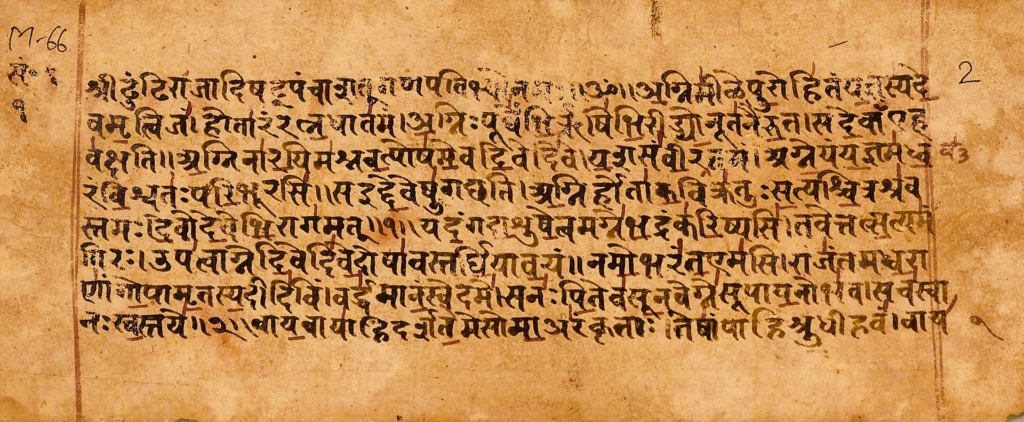
Social Structure and Everyday Life in the Rig Vedic Age
Another crucial aspect of the historical value of the Rig Veda lies in its detailed reflections of social life. Through its hymns, we glimpse how early Vedic communities lived, worked, and organized themselves.
Rig Vedic society was primarily pastoral. Cattle were the main measure of wealth. In fact, many conflicts described in the text were essentially cattle raids. Agriculture existed, but it was not yet dominant.
Family was the basic unit of society. The patriarch, or grihapati, led the household. Yet women were not entirely absent from public life. The Rig Veda mentions learned women such as Lopamudra and Ghosha, who composed hymns. This indicates that women could participate in intellectual and religious discourse.
Social divisions were present but not rigid in the early phase. The famous Purusha Sukta hymn refers to four varnas:
- Brahmana
- Kshatriya
- Vaishya
- Shudra
However, many historians argue that this classification developed gradually and was not yet a fully structured caste system during the early Rig Vedic period.
The hymns also reveal:
- Food habits (milk, ghee, barley)
- Clothing and ornaments
- Musical traditions
- Domestic rituals
Such details allow historians to reconstruct daily life with surprising clarity.
Unlike archaeological remains, which are silent, the Rig Veda speaks. It describes emotions, ambitions, fears, and aspirations of early Indo-Aryan communities. Therefore, its value as a social document is immense. It captures a civilization still in motion, before rigid hierarchies and urban expansion transformed the subcontinent.

Religious Beliefs and Worldview – Myth or History?
Religion dominates the Rig Veda. Yet even here, the historical value of the Rig Veda becomes visible when we read between the lines.
The hymns are dedicated to deities like Indra, Agni, Varuna, and Soma. These gods were not distant abstractions. They reflected the environment and concerns of early Vedic communities.
- Indra symbolized warfare and victory.
- Agni represented fire and sacrificial ritual.
- Varuna embodied cosmic order (rita).
From these deities, historians infer important aspects of society.
The prominence of Indra suggests a warrior culture. Frequent prayers for victory indicate a period of tribal conflict. Similarly, the centrality of Agni highlights the importance of ritual fire in domestic and public ceremonies.
The concept of rita, the cosmic order, reveals an early philosophical attempt to understand law, morality, and universal balance. This idea later evolved into the broader concept of dharma in Indian thought.
Sacrifices (yajnas) were central to religious life. These rituals required priests, offerings, and collective participation. This shows the emergence of specialized religious roles within society.
However, the Rig Veda does not describe temples or idol worship. Religion at this stage was more naturalistic and ritual-centered. This detail helps historians trace the evolution of later Hindu practices.
Thus, even mythology becomes historical evidence. Through gods and rituals, we uncover social priorities, environmental realities, and intellectual growth. The hymns may praise divine powers. But behind them stands a living society trying to understand its world.
Geographical References in the Rig Veda
Geography strengthens the historical value of the Rig Veda in a remarkable way. Unlike purely mythical texts, the Rig Veda names real rivers, regions, and landscapes.
The most celebrated geographical hymn is the Nadistuti Sukta (Hymn of the Rivers). It lists several rivers that flowed through the northwestern part of the Indian subcontinent.
Among them are:
- Sindhu (Indus)
- Saraswati
- Vipasha (Beas)
- Shutudri (Sutlej)
- Parushni (Ravi)
The prominence of the Sindhu River suggests that early Vedic communities lived in the Punjab and surrounding regions. The repeated praise of the Saraswati River indicates its significance in their cultural memory.
These references help historians identify the approximate geographical zone of the early Vedic people. Most scholars place them in the region of present-day northwest India and eastern Afghanistan. Importantly, the Rig Veda does not mention the Ganga frequently in its early layers. The absence of river Ganga in Rig Veda suggests that the eastern expansion toward the Gangetic plains happened later, during the Later Vedic period.
Such details allow historians to trace patterns of migration, settlement, and expansion. Unlike archaeological sites that must be excavated, these rivers flow directly through the text. They provide a map embedded in poetry.
Thus, the Rig Veda becomes not only a cultural record but also a geographical document of early India.
Limitations and Critical Evaluation – How Reliable is the Rig Veda?
While the historical value of the Rig Veda is undeniable, we must approach it with caution. It is not a chronicle in any manner. Rather, it is a sacred poetic text shaped by memory, ritual, and belief.
First, the Rig Veda was transmitted orally for centuries before being written down. Although the Vedic tradition preserved it with remarkable accuracy, the absence of precise dates makes chronological reconstruction difficult.
Second, the Rig Vedic hymns were composed by priests. Their purpose was religious, not historical. Events are often described in symbolic language. For example, battles often point divine victories rather than human conflicts. Such blending of myth and reality complicates interpretation.
Third, the text reflects the perspective of a specific group, primarily the Vedic Aryans. It tells us little about other contemporary communities, including those associated with the earlier urban civilization of the Indus region.
Fourth, it lacks systematic information. There are no continuous narratives, no clear timelines, and no administrative records. Historians must extract evidence indirectly.
Because of these limitations, the Rig Veda cannot stand alone as a historical source. It must be studied alongside:
- Archaeological findings
- Linguistic analysis
- Comparative Indo-European studies
- Later Vedic literatures
Yet limitations do not reduce its importance. Instead, they demand critical reading.
The Rig Veda is not a history book. But when interpreted carefully, it becomes one of the most valuable literary windows into ancient Indian civilization.
Conclusion: Why the Rig Veda Remains Indispensable for Historians
The historical value of the Rig Veda lies not in deliberate record-keeping, but in preservation. It preserves voices from one of the earliest phases of Indian civilization.
Through its hymns, we discover:
- Tribal politics and early governance
- Social organization and family life
- Religious beliefs and philosophical ideas
- Geographical landscapes of northwestern India
It reveals a society in transition — pastoral yet evolving, ritualistic yet intellectually curious, tribal yet politically aware.
No other literary source from this early period survives in such detail. Archaeology provides material remains. But the Rig Veda provides thought, language, emotion, and worldview. It allows historians to reconstruct events, alongside the thought behind it.
However, its use requires caution. It must be read critically. Myth must be separated from metaphor. Poetry must be examined alongside archaeology. Only then can its historical layers emerge clearly.
Yet despite its limitations, one fact remains undeniable: Without the Rig Veda, early Indian history would be far more silent. And that is precisely why it remains indispensable.
Frequently Asked Questions
The historical value of the Rig Veda lies in its detailed references to early Vedic society, tribal politics, religion, economy, and geography. Although it is a sacred text, historians use it as one of the earliest literary sources for reconstructing early Indian history.
The Rigveda is not a history book in the modern sense. It was composed as religious poetry. However, when studied critically and alongside archaeology and linguistics, it provides valuable historical insights.
The Rig Veda mentions tribal units called janas, chiefs known as rajan, and assemblies like sabha and samiti. It also describes inter-tribal conflicts such as the Battle of Ten Kings, helping historians understand early governance and warfare.
The text reflects a pastoral society where cattle symbolized wealth. It refers to family organization, roles of women, food habits, and the early concept of the four varnas. However, the caste system was not fully developed during the early Rig Vedic period.
The Rig Veda mentions rivers such as the Sindhu (Indus) and Saraswati. These references suggest that early Vedic communities lived in the northwestern region of the Indian subcontinent.
The Ganga appears rarely in the early layers of the Rig Veda. This suggests that the expansion toward the Gangetic plains happened later, during the Later Vedic period.
Nalanda University History – The Lost Intellectual Capital of Asia
History of Delhi: Rise, Destruction, and Rebirth of India’s Eternal Capital
Establishment of the Delhi Sultanate: How a New Era Began in India
The Making of Raigad: The Capital of Chhatrapati Shivaji Maharaj
Rajput Kingdoms: History, Culture, Dynasties and Their Legacy
History of the Maratha Empire: Rise, Expansion, and Fall of a Powerful Confederacy
Diamonds, Spices, and Horses: Global Trade of The Vijayanagara Empire
How Vijayanagara Empire Was Born: History of A Grand Revival

Chanakya and Nanda Dynasty: Ancient India’s History Changing Strategies

Chandragupta Maurya and Chanakya: Rise of the Mauryan Empire
Ancient Marathwada History – The Untold Trade Routes
