Standing tall on the shores of Odisha, the Konark Sun Temple is one of the top tourist destinations in Odisha, India. The horses, wheels and the eye catching architecture represent the giant chariot of Surya deva. Konark Sun Temple art, architecture and sculptures preserve a rich history, mystery and chemistry of medieval India. The temple also demonstrates deep knowledge in astronomy, engineering, and iconography of 13th century. In short, the Sun Temple of Odisha is the testimony of rich ancient Indian culture, architectural brilliance, exquisite artistry and a rich history.
Besides, ‘the land of temples’ has more than 700 temples across it. But the Sun Temple of Odisha is still valued among the best temples and the pride of Odisha. In 1984, the World Heritage Committee declared the Sun Temple of Konark a UNESCO Word Heritage Site. Konark is not just a temple but a timeless narrative carved in stone—depicting myths, and celestial symbolism.
Local Oriya speakers often call it the Konark Surya Mandir. Other local names include Arka Khetra and Padma Khetra. The main Konark temple idol is unfortunately missing today. And that makes the Konark Sun Temple history more interesting, mysterious. These 25 captivating facts will certainly unfold quite a few history, mystery and chemistry around the Konark Sun Temple.
Etymology of Konark
The meaning of word Konark lies in two Sanskrit words- Kona and Arka. In Sanskrit, Kona means angle and Arka means the Sun itself. Summing up, the word Konark means the angle of the Sun. Konark Sun Temple Chakra (wheel) was designed to calculate time, using the angle of the Sun. Hence, many historians believe in this theory.
Some historians although differ in the etymology of Konark. They believe Ganga dynasty kings have referred the northeast corner of Puri, with the word Kona. Circumstantially, the Jagannath temple of Puri was built by the same Ganga dynasty of Odisha, about a century ago.
Konark Sun Temple: Sources of Information
Historical texts, local legends, and accounts of travelers provided vital information about Konark Sun Temple. The Puri Jagannath Temple chronicle Madala Panji is another key source of Konark Sun temple information. Madala Panji described the temple as a colossal chariot of the Sun God and how it symbolizes the cosmic journey of time and life. Another Oriya script Baya Chakada also carry several facts about Konark Sun Temple construction.
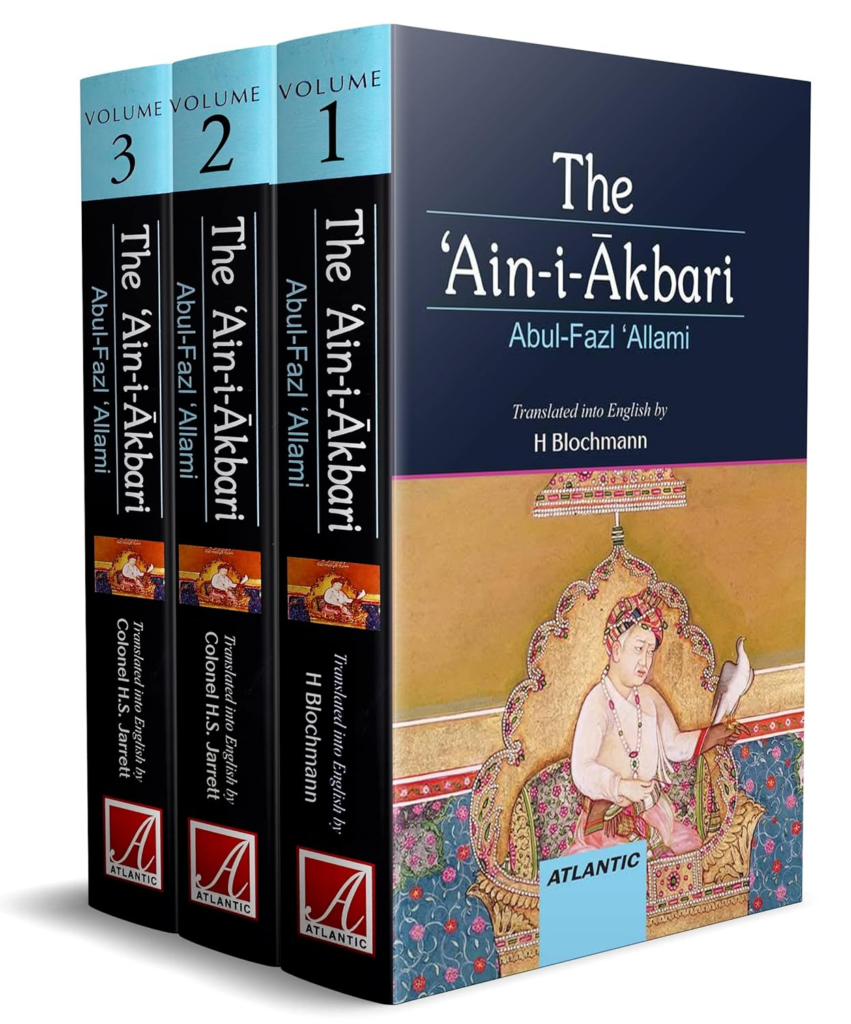
Abul Fazl has called the Sun temple of Konark as “Black Pagoda” in his Ain-i-Akbari. Abul Fazl’s account confirms the temple was famous in the court of Emperor Akbar as well. The Mughal historian and writer has admired the contributions of the chief builder of Konark Sun temple, Bishu Maharana. The book is also a testimony of many legends surrounding the temple’s incomplete construction.
Early European travelers and colonial-era historians including James Ferguson documented the temple’s architectural grandeur, intricate carvings, and spiritual significance. These accounts, merged with archaeological studies, offer a rich history, artistry, and cultural importance of Konark Sun Temple.
History of Konark Sun Temple
The history of Konark Sun Temple in Odisha dates back to 13th century. Alongside several debates, many fascinating facts about Konark Sun temple attract millions of history seekers. At the same time, spiritual and cultural legacy of Konark Sun Temple is hardly ignorable. The marvellous temple architecture and sculpture arts are yet unique among the Odisha heritage sites.
Konark Temple art and symbolism is a rarity found in the ancient Indian temples. It specifies why is Konark Sun Temple famous across India.
Who Built Konark Sun Temple and When?
Archaeological evidences and historical records suggest that the temple is more than 700 years old. Ganga dynasty king Narasimhadeva built the Konark Sun Temple around 1250 CE. The Konark Sun temple founder wanted to commemorate his victory over the Muslim invaders. King Narasimhadeva had appointed the famous engineer-builder Bisu Maharana for the construction work.
Interestingly, Ain-i-Akbari described Konark Sun Temple was built around 850 CE. Archaeologists like James Fergusson had already supported this theory. Few other scholars claim that the temple was built during 9th century. However, majority of claims consider king Narasimhadeva as the founder of Konark Sun temple.
Cost of Construction
None of the historical accounts mention any exact construction cost of Konark Sun Temple. But the architecture and long construction timelines demonstrate that the cost was not anyways small.
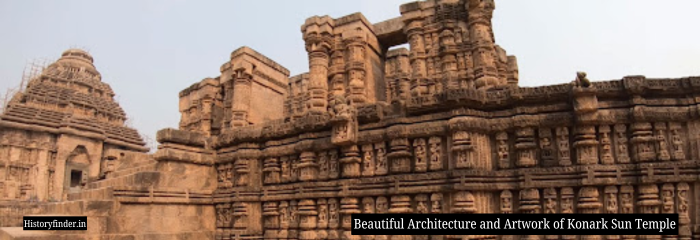
King Narasimhadeva ordered to finish the temple construction within 12 years. Bisu Maharana, the chief architect of Konark temple had appointed 12,000 workers for the construction. But unfortunately, they proved themselves inefficient to finish the work on time. Konark Sun Temple was built using three types of stones. Konark temple sculptures, doors and frames were made of Chlorite. Use of Laterite stones are visible for temple platforms and staircases. Other areas of the temple have use of Khondalite rocks. Majority of rocks and stones were brought from Udaigiri and Khandagiri hills.
Various legends mention that King Narasimhadeva had to invest all his revenues collected during the 12 years of construction. According to a historical account, Konark Sun temple cost was 48 lakh Madha (local currency) that period. Some modern analysts propose that the cost would be around Rs 400 crore in today’s valuation.
Why Left Incomplete?
Historical evidences suggest that Konark temple was never completed. Many historians claim that early death of king Narasimhadeva led stoppage in the Konark temple construction. It never restarted again. Nevertheless, another theory claims, Bisu Maharana, the chief architect of Konark Sun Temple missed the deadline. It led the king ordering the stoppage of work.
Dharmapada story is very famous among the Konark Sun Temple myths in this aspect. Few complications arrived while installing the Dadhi Nauti, the crown stone, causing the builder missed his construction deadline. Willing to divert the king’s anger, Dharmapada, son of Bisu Maharana, jumped into river Chandrabhaga from the temple top. According to the experts, death of Dharmapada was one of strongest reasons why Konark Sun Temple construction was stopped. This Dharmapada story is also taken as the reason why Konark Sun Temple has never worshiped the god of Sun.
Did Chandrabhaga River Really Existed Beside Konark Temple?
Many historical accounts defy the Chandrabhaga river story around the Sun temple of Odisha. They firmly claim that Chandrabhaga river story is just like the other myths about Konark Sun temple, without any proof. Irrespective of its truness, it tells that Konark temple was built at the river mouth of Chandrabhaga river. The founder of Konark temple, King Narasimhadeva had to fill the river gorge with giant stone blocks.
Some scholars disagree mentioning two reasons:
Firstly, no traces of Chandrabhaga river is found today.
Secondly, even it did ever exist, everyone would try to avoid to fill the land with huge stone blocks. Instead, the king would easily select an alternate land, from many more options available.
Konark Temple Orientation
The orientation of Konark Sun Temple is the most notable feature of the most prominent temple architecture of Odisha. Remarkably, it symbolizes the god of Sun journey through the day, month and year. The first ray of sunlight would illuminate the temple main entrance first. Then, as the day progresses, the god of Sun continues his journey, the rear sections of the temple starts illuminating. Historical records describe it would then illuminate sanctum (ruined today), creating a spiritual vibe. Konark Sun Temple
A Gigantic Chariot
According to the Hindu Vedic philosophy, Lord Surya travels from east towards west during the day. Seven horses drag his chariot through the sky. The Konark temple design depicts a colossal chariot of Lord Surya. His chariot consists of 12 pairs of exquisitely carved wheels and seven horses. Each wheel functions as a sundial, that marks his progress in the day’s journey.
Time Calculation with Konark Chakras (Wheel)
Konark Sun Temple Chakras, the chariot wheels, hold immense architectural, cultural and symbolic significance. The intricate carvings represent marvelous artistry, with a prefect blend of spiritual and functional side of life. The most interesting part of the Konark temple chariot wheels lie in represention of a sundial. The chariot of the god of Sun had 12 pairs of Chakras (wheels), representing 12 months of the year.
Each wheel has 8 thick and 8 thin spokes, representing 8 prahars (a three hour interval) and 8 half-prahars of a day. Each prahar is further subdivided by 60 smaller beads at the wheel periphery. They represent the smallest time intervals of 3 minutes each.
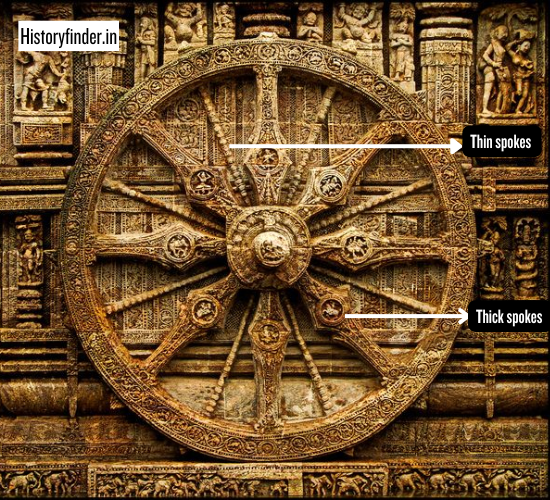
It is indeed surprising how one can measure exact time with Konark Temple chariot wheel. You just need to put your finger on the axle of the wheel. The shadow of your finger falling on the spokes or the beads would determine the exact time of the day. It demonstartes the deep knowledge of engineering and astronomy in 13th century.
Intricate Carvings Depicting Daily Life
Exquisite stone carvings appear on all over the temple walls. The carvings include purely decorative geometric patterns, plant motifs, marching soldiers, hunting scenes, caravans and carts etc. Temple terraces contain stone statues of male and female musicians, holding various musical instruments. Other artworks include sculptures of Hindu deities and apsaras.
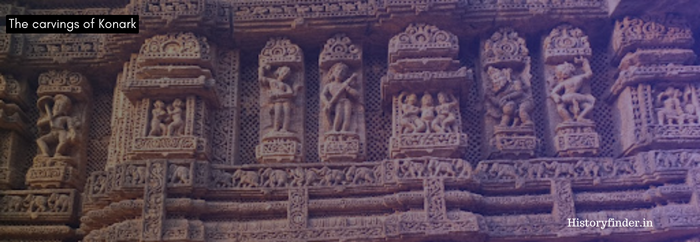
Konark Chariot carvings depict many Artha and Dharma scenes, the daily life and culture of the people. The daily life scenes include hunting, royal court scenes, musicians, and dancers, offering a cultural glimpse of 13th-century Odisha.
Erotic Sculptures and Symbolism
The erotic sculptures of the Konark Sun Temple are not just artistic expressions. But hold profound cultural, philosophical, and spiritual significance. Kama (desire) is one of the four Purusharthas (goals of human life), alongside Dharma (righteousness), Artha (wealth), and Moksha (liberation). These sculptures represent the acknowledgment of human desires as a natural and celebrated aspect of life.
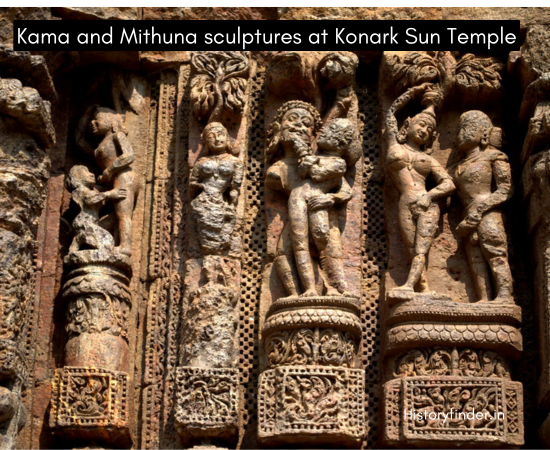
Many historians had claimed that Konark Sun Temple erotic sculptures may have served as an educational tool for medieval society. The Kama and Mithuna sculptures illustrate love and intimacy of relationships. Another probable reflection is the cultural openness, that encouraged balanced living, respecting all aspects of human existence.
Invasion by Kalapahad
Konark Sun Temple history is featured by several Muslim invasions. A folklore describes Kalapahad, a converted Muslim general, invaded Konark temple in 1568. Madala Panji described Kalapahad invading multiple Hindu temples in Odisha at that time. But there is no concrete evidence whether Kalapahad invaded Konark or not.
Marine Navigation of Medieval Era: Black Pagoda
Due to its adjacency to the coast, Konark temple had served as an important navigational landmark during medieval era. Black granite stones and unique architecture of Konark Sun Temple would appear like a black tall tower with multiple tiers. The 229 feet tall temple was easily visible for far and would navigation very easy for the sailors. European sailors had named Konark Sun temple ‘Black Pagoda’, for its blackish pagoda (multi-level tall tower) look.
Contextually, they called Jagannath temple of Puri as ‘White Pagoda’ for similar reasons.
Floating Idol mystery of Konark Temple
The legendary story of Konark Sun Temple floating idol is still a mystery today, lacking any archaeological evidence. According to folklore, the sanctum of Konark Temple once housed a giant idol of the Sun, floating in the air. Konark Sun Temple crowing stone (Kalasha) was said to be a 52 ton giant magnet. The Sun god’s idol was also said to be made of a special metal. It would create a magnetic field strong enough to hold the hold giant idol in the air.
The absence of the Konark Temple Shikhara and the surviving magnets today, make it difficult to verify any such claims. Further, truthfulness of such a large earthen magnet (magnetite) had always been questionable to the scholars. Nevertheless, despite the uncertainty, the Konark Sun Temple floating idol story remains a captivating aspect of the temple’s mystery.
Destruction by the Portuguese Sailors
The giant magnet crown stone of Konark temple is said to cause navigation problems to the Portuguese sailors. A legend mentions, it led the Portuguese sailors removed the Konark crown stone to avoid the problem.
Many historians, however, reject such claims. Despite the hugeness of the Konark magnet crown stone, causing navigation problems such far into the sea, didn’t seem practical. More importantly, no evidence of such removal was ever found. But, irrespective of the truthfulness, removal of Konark crown stone has remained major mystery of Konark Sun Temple history.
Symbolic Artistry of Konark Nara-Gaja-Simha Sculpture
Nara-Gaja-Simha (human elephant lion) sculpture of Konark Sun Temple is a remarkable representation of symbolic artistry. The iconic sculpture typically depicts a lion atop an elephant, both standing on a human figure.
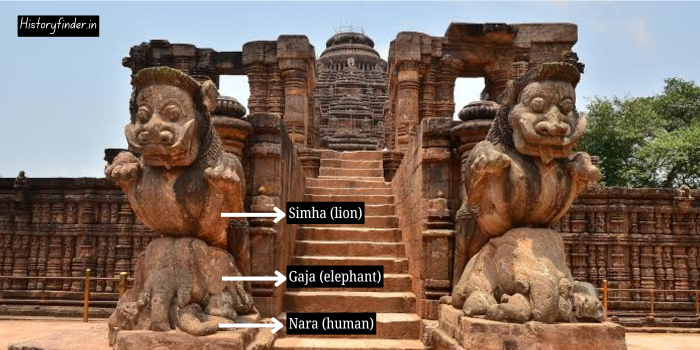
Lion, mount of Hindu goddess Durga, symbolizes the aggression or arrogance of human being. On the other side, elephant represent materialistic wealth. The Nara-Gaja-Simha sculpture hence symbolize how human desire of wealth and arrogance can ruin his life.
Konark Sun Temple Worship Controversy
Worship of Lord Suryanarayana is among the strongest controversies of Konark Sun Temple. Few historians believe that the temple was never completed or, collapsed soon after construction. Hence, the temple never worshiped the god of Sun. Their claim further strengthens with finding of many parts of Konark temple, never taken to the temple top.
But old Oriya accounts like Madala Panji mentions about completion of Konark temple construction. Hence, possibility of worship of the god of Sun is high. Similarly, Ain-i Akbari also never mentioned about ruined condition of Konark Sun Temple. Such facts made many scholars doubting the folklore that Konark Sun Temple had never worshiped Suryanarayana, the god of Sun.
Interestingly, Madala Panji describes about the distribution of responsibilities for various daily rituals and festivals conducted in the Sun Temple. It also describes increased allotment of funds by the King.
Removal of Sculptures
Aruna Stambha (Aruna pillar) once glorified the entrance of Konark temple. The 33 feet 8 inches (10.26 m) tall monolithic chlorite pillar was dedicated to Aruna, the charioteer of the Sun god. During late 18th century, Goswain, a Maratha Brahmachari, taken and installed at Singha Dwara of Puri Jagannath Temple.
Raja of Khurda during early 19th century, removed some stones and sculptures from Konark Temple. He used the sculptures to build a temple in Puri. Few gateways and sculptures were destroyed in the process.
In 1894 thirteen sculptures were moved to the Indian Museum. Later, accepting the demand of local Hindu population, the government stopped further removal of items from the temple.
Restoration and Preservation Initiatives
In 1803, the East India Marine Board requested the Governor General of Bengal to prohibit further removal of stones. It was the first initiative ever made for preservation of Konark Sun Temple. In 1903, J. A. Bourdillon, Lieutenant governor of Bengal, released order to seal and fill up Konark Temple Jagamohana with sand. Two years later, the structure of Mukhasala and Nata Mandir was also repaired.
Legacy of Konark Sun Temple
In summary, the Konark Sun Temple wheels are not merely architectural elements but a profound symbol of India’s heritage. It symbolizes India’s architectural genius and spiritual devotion. Designed as a chariot of the Sun God, it features intricate carvings depicting celestial beings, animals, and human life. Konark temple, representing the zenith of Kalinga architecture, showcases advanced engineering. Despite suffering partial collapse, Konark Sun Temple remains a cultural and historical icon, inspiring artists, poets, and pilgrims for centuries.
You May Also Like:
Nalanda University History – The Lost Intellectual Capital of Asia
Historical Value of the Rig Veda as a Source of Early Indian History

History of Delhi: Rise, Destruction, and Rebirth of India’s Eternal Capital
Establishment of the Delhi Sultanate: How a New Era Began in India
The Making of Raigad: The Capital of Chhatrapati Shivaji Maharaj
Rajput Kingdoms: History, Culture, Dynasties and Their Legacy
History of the Maratha Empire: Rise, Expansion, and Fall of a Powerful Confederacy
Diamonds, Spices, and Horses: Global Trade of The Vijayanagara Empire
How Vijayanagara Empire Was Born: History of A Grand Revival

Chanakya and Nanda Dynasty: Ancient India’s History Changing Strategies

Chandragupta Maurya and Chanakya: Rise of the Mauryan Empire
Ancient Marathwada History – The Untold Trade Routes

Independence Day of India: Why August 15, 1947 Was Chosen?

Vedic Wisdom Explained: Ancient Insights for Modern Life