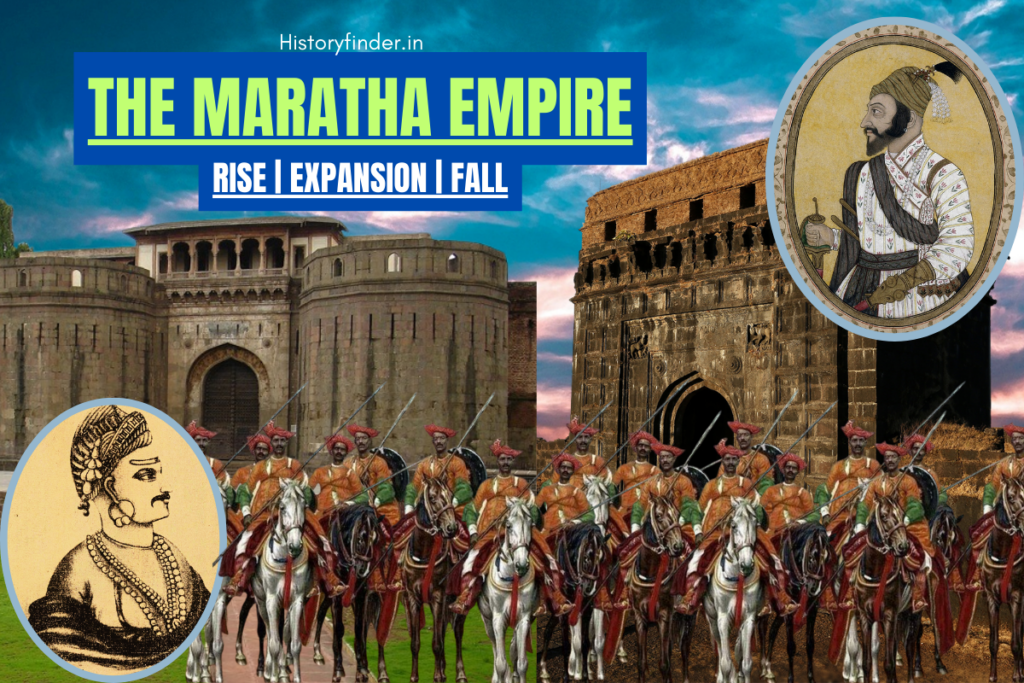
In the 17th century, the Mughal Empire appeared unshakable. Its armies stretched across the subcontinent. The Mughal throne commanded wealth and authority, only a few could challenge. Yet in the rugged hills of the Deccan, a new force was quietly gathering strength. The history of the Maratha Empire begins not with inherited power, but with resistance.
Shivaji Maharaj did not command vast armies in the beginning. He commanded resolve. He understood terrain. More importantly, he built alliances. Shivaji Maharaj inspired loyalty among local warriors who knew the mountains better than imperial generals.
What began as a regional assertion of autonomy evolved into a political revolution.
Within decades, the Marathas would challenge Mughal supremacy. Within a century, they would dominate large parts of India. Their confederacy would stretch from the Deccan to the gates of Delhi.
This was not merely the rise of a kingdom. It was the emergence of a new political order—decentralized, mobile, and fiercely strategic.
To understand how this transformation unfolded, we must first examine the world into which Shivaji was born.
Political Background: Crisis Before the Rise of the Maratha Empire
Before the rise of the Maratha Empire, the Deccan stood divided and unstable. The once-powerful Bahmani Sultanate had fragmented into smaller Deccan kingdoms like the Ahmadnagar Sultanate, Bijapur Sultanate, and Golconda Sultanate. These states fought one another for territory and influence. Their internal rivalries weakened them.
Meanwhile, the Mughal Empire steadily pushed southward. Under emperors like Shah Jahan and later Aurangzeb, the Mughals sought to control the Deccan’s trade routes, forts, and revenue networks.
This created a power vacuum at the local level.
Maratha chiefs served as military commanders and local administrators under Deccan sultans. They gained experience in warfare, revenue collection, and fort management. Yet they lacked sovereign authority. They operated within systems controlled by larger Islamic courts.
Into this fractured political landscape, Shivaji was born in 1630 at the hill fort of Shivneri Fort. His father, Shahaji Bhonsle, served the Bijapur Sultanate. But Shivaji did not inherit an empire. He inherited opportunity.
The Deccan’s geography favored guerrilla warfare. Its hills and dense forests limited the effectiveness of large imperial armies. Shivaji understood this strategic advantage early. He built his power slowly—fort by fort, alliance by alliance.
Thus, the history of the Maratha Empire did not begin with a declaration. It began with calculated defiance in a politically unstable Deccan.
Shivaji and the Foundation of the Maratha State
The history of the Maratha Empire truly begins with action. Shivaji Maharaj did not wait for permission. In 1646, he captured Torna Fort—his first decisive move against the authority of the Bijapur Sultanate. He followed it with a rapid series of fort seizures across the Western Ghats.
He did not rely on massive armies. Rather, he relied on speed, surprise, and terrain.
Shivaji Maharaj perfected guerrilla warfare—ganimi kava. His forces struck quickly, avoided prolonged battles, and vanished into the hills. Larger imperial forces struggled to respond.
His growing influence alarmed both Bijapur and the Mughal Empire.
One defining moment came in 1659. The Bijapur general Afzal Khan marched to crush him. Instead, Shivaji outmaneuvered and defeated him near Pratapgad. This victory transformed Shivaji from a regional rebel into a serious political force.
Conflict with the Mughals followed. In 1666, Shivaji faced humiliation at the court of Aurangzeb in Agra. Yet he escaped captivity in a daring episode that enhanced his legend across India.
But military success alone did not build an empire.
In 1674, at Raigad Fort, Shivaji formally crowned himself Chhatrapati. This coronation signaled sovereignty. He established an organized administration, introduced revenue reforms, and created the Ashta Pradhan council to manage governance. He strengthened forts as strategic hubs rather than symbolic structures. But the navy Shivaji Maharaj build to protect the Konkan coast was a strategic masterpiece.
Shivaji did not merely resist imperial authority—he constructed an alternative state.
By the time of his death, he had laid a durable political foundation. The Maratha state was no longer a rebellion. It had become a rising power.
Expansion After Shivaji: From Kingdom to Confederacy
When Shivaji died in 1680, the Maratha state faced its first great test.
The Mughal Empire did not wait. Emperor Aurangzeb personally led a massive Deccan campaign. For nearly three decades, Mughal armies attempted to crush Maratha resistance.
Yet they failed.
Shivaji’s son Sambhaji fought fiercely but fell to the Mughals in 1689. Many believed the Maratha movement would collapse. Instead, it hardened. Rajaram continued resistance from fortified strongholds in the south. After his death, Tarabai emerged as a determined leader, sustaining guerrilla warfare against imperial forces.
Aurangzeb spent the final years of his life trapped in a draining Deccan war. When he died in 1707, the Mughal Empire stood exhausted. The Marathas stood resilient.
In fact, the death of Aurangzeb shifted the balance of power.
Under Peshwa leadership, especially Bajirao I, the Marathas transformed from a regional kingdom into a mobile, expanding confederacy. Bajirao understood momentum. He led rapid northern campaigns, striking deep into Mughal territory.
By the 1730s, Maratha influence extended into Malwa, Gujarat, Bundelkhand, and even Delhi. In 1737, Bajirao’s forces reached the outskirts of the Mughal capital, demonstrating how dramatically power had shifted. The Maratha Empire no longer defended hills alone. It projected power across the subcontinent.
Yet this expansion brought new challenges. Authority decentralized. Powerful chiefs such as the Holkars, Scindias, Gaekwads, and Bhonsles controlled vast territories under the Maratha banner. The empire evolved into a confederacy—dynamic, expansive, but increasingly complex.
The rise had been swift. The dominance was undeniable. But with vast expansion came fragile unity.
The Third Battle of Panipat: The Turning Point (1761)
By the mid-18th century, the Maratha Confederacy stood at the height of its power. Its armies controlled Delhi. Its influence stretched from the Deccan to the northwest. The weakening Mughal Empire survived largely under Maratha protection.
But expansion brought confrontation.
In the northwest, the Afghan ruler Ahmad Shah Durrani (also known as Ahmad Shah Abdali) invaded India repeatedly. His campaigns aimed to check Maratha influence and secure Afghan dominance over Punjab and Delhi.
Tension escalated into one of the largest battles of the 18th century—the Third Battle of Panipat.
On 14 January 1761, near Panipat in present-day Haryana, massive armies faced each other. The Marathas, led by Sadashivrao Bhau and supported by Vishwasrao, fought far from their Deccan base. Supply lines stretched thin. Local alliances remained fragile.
Despite their courage and artillery strength, the Marathas suffered a devastating defeat.
The loss shattered northern ambitions. Thousands of soldiers and leaders perished. Political morale collapsed. The dream of direct Maratha dominance over North India faded.
Yet Panipat did not destroy the Maratha Empire.
Within a decade, leaders like Madhavrao I revived Maratha power in the Deccan. The confederacy regained influence in central India. But something had changed permanently.
After Panipat, the Marathas expanded cautiously. Internal rivalries deepened. The opportunity for another rising power, the British East India Company, began to grow.
Panipat did not end the Marathas. It reshaped their destiny.
Decline and Fall of the Maratha Empire
After the shock of the Third Battle of Panipat, the Marathas recovered—but unity weakened. The confederacy structure gave powerful chiefs autonomy. The Holkars in Indore, the Scindias in Gwalior, the Gaekwads in Baroda, and the Bhonsles in Nagpur pursued regional ambitions. Coordination suffered. Rivalries intensified.
Meanwhile, a new power expanded steadily—the British East India Company.
Unlike earlier invaders, the Company combined diplomacy, military discipline, and financial strength. It intervened in Indian politics through treaties, subsidies, and strategic wars.
Conflict became inevitable.
The Anglo-Maratha Wars (1775–1818) unfolded in three major phases. In the first two wars, the Marathas still demonstrated resilience. They forced negotiations and retained influence. But by the Third Anglo-Maratha War (1817–1818), British superiority in organization and unified command proved decisive.
The last Peshwa, Baji Rao II, failed to rally the confederacy effectively. British forces defeated key Maratha leaders one by one. Consequently, the territories fell. Autonomy shrank.
In 1818, the Peshwa surrendered. The British annexed core Maratha lands. This ended the rule of Maratha Empire formally. But its legacy did not vanish.
The Marathas had challenged the Mughal Empire at its peak. They had reshaped 18th-century Indian politics. They had created a decentralized power model that dominated the subcontinent for decades.
The history of the Maratha Empire stands not as a brief rebellion, but as a decisive chapter in India’s transition from Mughal supremacy to colonial rule.
Conclusion: Power, Fragmentation, and Legacy
The history of the Maratha Empire is not simply a story of rise and fall. It is a story of transformation.
From the daring vision of Shivaji Maharaj to the vast confederacy that overshadowed the declining Mughal Empire, the Marathas redefined power in 18th-century India. They replaced centralized imperial dominance with a mobile, regionally anchored political network. In doing so, they proved that strategy, speed, and local legitimacy could challenge even the mightiest empire.
Yet expansion without cohesion carries risk.
Internal rivalries weakened collective strength. The confederacy model, once a source of flexibility, limited unified resistance against the rising British East India Company. By 1818, military defeat ended Maratha sovereignty, but not their historical significance.
The Marathas bridged two eras. They accelerated the collapse of Mughal authority and shaped the political landscape that the British later inherited. Their empire did not simply disappear. Rather, it altered the balance of power in India and left a legacy of resilience, statecraft, and regional assertion that continues to influence historical memory.
The Maratha Empire rose from the hills of the Deccan. It challenged empires. And for nearly a century, it commanded the destiny of the subcontinent.
Frequently Asked Questions
The history of the Maratha Empire began in 1674 when Shivaji crowned himself Chhatrapati at Raigad. However, his early military campaigns started in the 1640s.
Shivaji Maharaj founded the Maratha Empire. He built a strong administrative system, organized guerrilla warfare tactics, and established sovereign rule in the Deccan region.
Under leaders like Baji Rao I, the Marathas used swift cavalry movements, flexible military strategy, and political alliances to expand into North and Central India during the 18th century.
The major turning point came at the Third Battle of Panipat. The Marathas suffered a heavy defeat against Ahmad Shah Durrani, which weakened their northern ambitions.
Internal rivalries within the confederacy and repeated conflicts with the British East India Company led to decline. The Third Anglo-Maratha War (1817–1818) ended Maratha political dominance.
The Maratha Empire formally ended in 1818 after the British defeated the last Peshwa, Baji Rao II.




Pingback: Raigad Fort History | The Rise of Shivaji Maharaj's Capital - History Finder