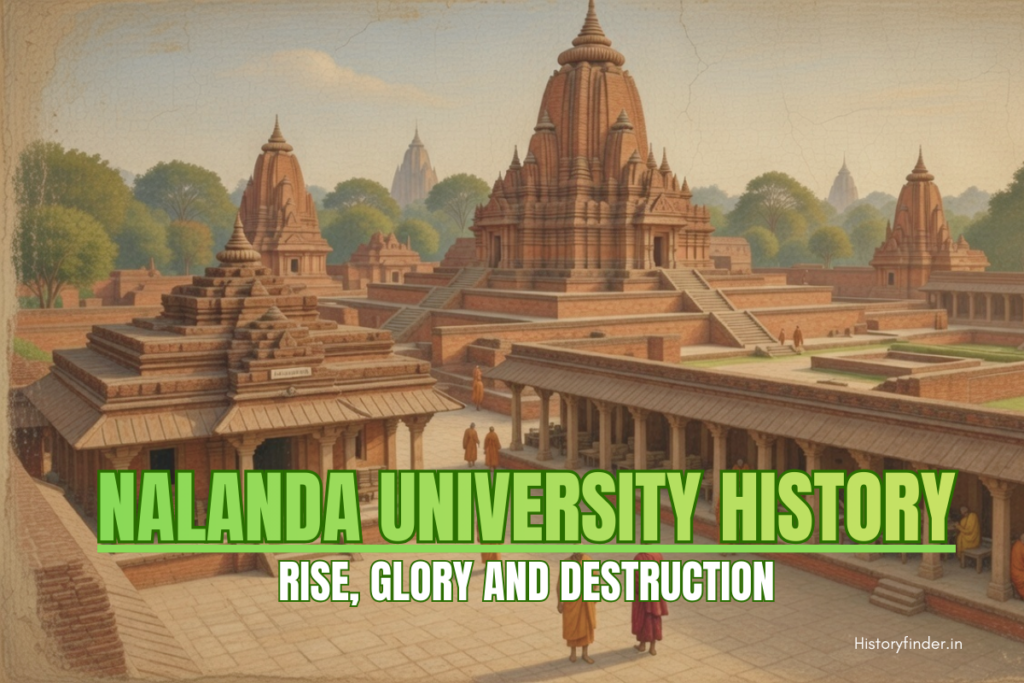
History does not always begin with war. Nalanda University history begins with an idea — that knowledge deserves a sanctuary. In the 5th century CE, during the reign of the Gupta emperors, a remarkable institution took shape in present-day Bihar. Kumaragupta I is widely credited with supporting its foundation. What started as a modest Buddhist monastery slowly transformed into something far greater.
Nalanda did not rise overnight.
It grew because the Gupta kings believed in scholarship. They donated land, funded buildings, and further, protected monks and teachers. Over time, brick by brick, courtyard by courtyard, Nalanda expanded into a vast residential university.
Monasteries lined the campus. Lecture halls echoed with debate. Students did not merely attend classes, rather they lived inside an ecosystem of learning.
Unlike many ancient centers of study, Nalanda imposed strict entry standards. Visiting scholars describe a rigorous oral examination at the gates. Only the most prepared students gained admission. Those who entered studied philosophy, grammar, logic, medicine, astronomy, and Buddhist theology.
The location also helped. Nalanda stood along important trade and pilgrimage routes. Travelers carried its reputation across regions. The world started knowing, that it was not just a monastery. Nalanda was becoming the intellectual heartbeat of the subcontinent. And this was only the beginning.
The Glory of Nalanda – When Asia Came to Learn
How does an institution earn continental authority? Nalanda University history reaches its peak between 5th-9th century. The scholars across Asia recognized it as a leading center of higher learning, rather than merely a monastic establishment.
By the 7th century, Nalanda had developed into an international academic hub.
The Chinese monk Xuanzang studied there for several years under the scholar Shilabhadra. His detailed account remains one of the most important historical sources on Nalanda. He described a structured curriculum, disciplined monastic life, and a highly competitive admission process. Only students who could defend their knowledge in oral examinations were admitted.
Available on Amazon
[This is an affiliate link. Your purchase helps support historyfinder.in at no extra cost to you]
Another traveler, Yijing, confirmed Nalanda’s reputation. He noted the presence of thousands of students and teachers. While exact figures may be debated, the scale of operations was clearly large for its time.
Nalanda offered instruction in:
- Buddhist philosophy (especially Mahayana)
- Logic and debate
- Sanskrit grammar
- Medicine
- Astronomy and mathematics
Debate formed a core part of academic training. Scholars engaged in formal intellectual exchanges, and mastery of logic enhanced both reputation and institutional standing.
Dharmaganja—the massive, legendary library serving as the intellectual heart of Nalanda University complex. It reportedly consisted of three multi-storied buildings—Ratnasagara, Ratnodadhi, and Ratnaranjaka, housing hundreds of thousands of manuscripts on Buddhism, logic, medicine, astronomy, and mathematics. Such emphasis on preservation and commentary allowed Nalanda to function both as a teaching center and a research institution.

Royal patronage from rulers such as Harsha and the Pala kings ensured financial stability. At the same time, the university maintained intellectual autonomy.
Nalanda’s influence extended beyond India. Graduates and visiting scholars transmitted its ideas to Tibet, China, and Southeast Asia, shaping Buddhist philosophy across the region.
At its height, Nalanda represented a rare combination of scale, specialization, and international engagement — features that defined its intellectual supremacy.
The Destruction of Nalanda – Historical Evidence and Debate
No account of Nalanda University history is complete without examining its decline and destruction. By the late 12th century, political conditions in eastern India had changed significantly. The Pala dynasty, long-time patrons of Nalanda, had weakened. Without strong royal protection, major institutions became vulnerable.
The most widely cited account links Nalanda’s destruction to the Turkish military commander Bakhtiyar Khilji. According to later Persian chronicles, particularly those written by Minhaj-i-Siraj, Khilji attacked a fortified structure in Bihar around 1193 CE. Many scholars identify this site as Nalanda.

Tibetan sources, written centuries later, describe monasteries being burned and monks killed. They also suggest that Nalanda’s vast library was set on fire. Some accounts claim the manuscripts of Nalanda burned for months. However, these details are difficult to verify fully through archaeology alone.
Excavations at Nalanda reveal layers of destruction and burning. This supports the view that the site experienced violent damage. At the same time, evidence also indicates that Nalanda had already begun declining before the final assault. Reduced patronage and shifting political power had weakened its institutional structure.
Therefore, historians today take a nuanced position:
- Nalanda likely suffered a major attack in the late 12th century.
- Its decline had begun earlier due to political instability.
- The idea of a single-day collapse oversimplifies a longer process of weakening and destruction.
The end of Nalanda marked more than the fall of a university. It represented the collapse of a long-standing intellectual network that had connected India with much of Asia.
After the 13th century, Nalanda never regained its former prominence. Its buildings fell silent. But its intellectual legacy survived in texts carried abroad.
Historiographical Debates – How Scholars Interpret Nalanda
Modern understanding of Nalanda University history does not rely on a single narrative. It relies on archaeology, Chinese travel accounts, Tibetan chronicles, and Persian court histories. As a result, historians, in many cases, differ in emphasis and interpretation.
1. Archaeological Perspective
Excavations led by the Archaeological Survey of India in the early 20th century uncovered monasteries, temples, and structural remains spread across a large campus. The physical scale of the archaeological discovery confirms Nalanda’s institutional significance.
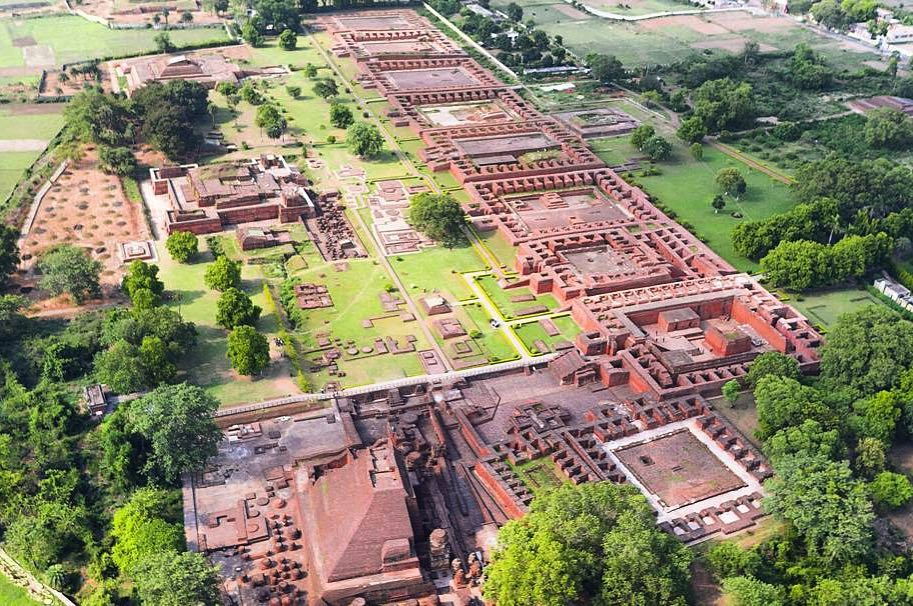
But at the same time, material evidence alone cannot confirm the dramatic details about its final destruction. Burnt layers indicate fire damage, but they do not precisely document the sequence of events.
2. Chinese Accounts as Primary Evidence
Much of what we know about Nalanda’s academic structure comes from the accounts of Xuanzang and Yijing. Many modern historians treat their records as highly valuable but not free from exaggeration.
Some scholars suggest that reported numbers, such as 10,000 students — may be symbolic or rounded figures. But even if we reduce, the scale still remains impressive, considering the period.
The consensus view is that these travelers offer credible descriptions of curriculum, debate culture, and monastic discipline.
3. Debate Over the “Single Destruction” Narrative
The account of Bakhtiyar Khilji’s attack largely comes from Persian historian Minhaj-i-Siraj. Some modern historians, though accept this as the primary cause of Nalanda’s fall.
But many others argue for a broader explanation:
- The weakening of Pala patronage
- Political fragmentation in eastern India
- Shifts in religious and intellectual centers
They suggest that Nalanda’s decline was gradual, with the military attack acting as the final blow rather than the sole cause.
4. Intellectual Significance in Global Context
Modern scholars of Buddhism emphasize Nalanda’s influence on Tibetan monastic universities. The philosophical systems taught at Nalanda continued to shape Buddhist thought long after the physical campus declined.
In this sense, some experts argue that Nalanda was destroyed as an institution, but not as an intellectual tradition.
5. Contemporary Reinterpretations
In recent decades, Nalanda has also entered public and political discourse. It is often portrayed as a symbol of India’s ancient academic excellence. While this perspective highlights its achievements, academic historians stress the need for evidence-based interpretation rather than romanticization.
Balanced Assessment
Most experts agree on three points:
- Nalanda was a major center of learning for several centuries.
- It declined due to both political weakening and external attack.
- Its intellectual influence survived beyond its physical destruction.
Thus, the study of Nalanda requires both critical distance and recognition of its genuine historical significance.
Conclusion – Assessing Nalanda in Historical Perspective
Nalanda University history demonstrates how institutions emerge, flourish, and decline within broader political and intellectual frameworks.
Its rise was closely tied to Gupta and later Pala patronage. Royal support provided economic stability, land grants, and institutional continuity. Its growth was not accidental; it reflected deliberate state investment in scholarship.
Its glory rested on three foundations:
- A structured and rigorous academic culture
- International engagement through scholars like Xuanzang and Yijing
- A strong manuscript preservation system centered around its library
Nalanda functioned as a residential, multidisciplinary institution with high admission standards. It combined monastic discipline with advanced philosophical training. This model enabled it to influence intellectual traditions across Tibet, China, and Southeast Asia.
How Nalanda University declined, however, cannot be explained by a single event. The weakening of political patronage reduced institutional resilience. The military campaign of Bakhtiyar Khilji in the late 12th century likely accelerated or finalized its collapse. Archaeological and textual evidence together suggest both gradual weakening and violent disruption.
From a historiographical standpoint, Nalanda should be understood neither as a romanticized utopia nor as a simplified victim of sudden destruction. It was a historically situated institution shaped by economic, political, and religious currents.
Its physical campus disappeared. Its intellectual systems did not.
The continued presence of Nalanda-based philosophical traditions in Tibetan Buddhism confirms that its influence outlived its architecture.
Therefore, Nalanda occupies a critical position in ancient Indian and Asian history — not merely as a symbol of lost greatness, but as a case study in how knowledge networks rise, expand, and transform across regions.
Frequently Asked Questions (FAQs)
Nalanda University was one of the world’s earliest residential universities and a major center of higher learning in ancient India. It influenced Buddhist philosophy, logic, medicine, and intellectual traditions across Asia.
Nalanda was established in the 5th century CE, most likely during the reign of the Gupta ruler Kumaragupta I. It expanded significantly under later rulers such as Harsha and the Pala kings.
Chinese traveler Xuanzang recorded that around 10,000 students and 2,000 teachers were present at Nalanda. While historians debate the exact numbers, it was undoubtedly one of the largest academic institutions of its time.
Nalanda offered instruction in Buddhist philosophy, logic, Sanskrit grammar, medicine, astronomy, mathematics, and debate. It functioned as a multidisciplinary center of advanced study.
Most historical accounts attribute the destruction of Nalanda to the Turkish commander Bakhtiyar Khilji in the late 12th century. However, historians note that the university had already begun declining due to weakened political patronage before the final attack.
Yes. Nalanda housed a large manuscript collection known as Dharmaganja. Historical accounts describe it as an extensive multi-building library complex that played a key role in preserving Buddhist texts.
Nalanda was located in present-day Bihar, India, near Rajgir. The archaeological remains are now a UNESCO World Heritage Site.

Historical Value of the Rig Veda as a Source of Early Indian History

History of Delhi: Rise, Destruction, and Rebirth of India’s Eternal Capital

Establishment of the Delhi Sultanate: How a New Era Began in India
The Making of Raigad: The Capital of Chhatrapati Shivaji Maharaj
Rajput Kingdoms: History, Culture, Dynasties and Their Legacy

History of the Maratha Empire: Rise, Expansion, and Fall of a Powerful Confederacy
Diamonds, Spices, and Horses: Global Trade of The Vijayanagara Empire

How Vijayanagara Empire Was Born: History of A Grand Revival

Chanakya and Nanda Dynasty: Ancient India’s History Changing Strategies

Chandragupta Maurya and Chanakya: Rise of the Mauryan Empire

Ancient Marathwada History – The Untold Trade Routes
