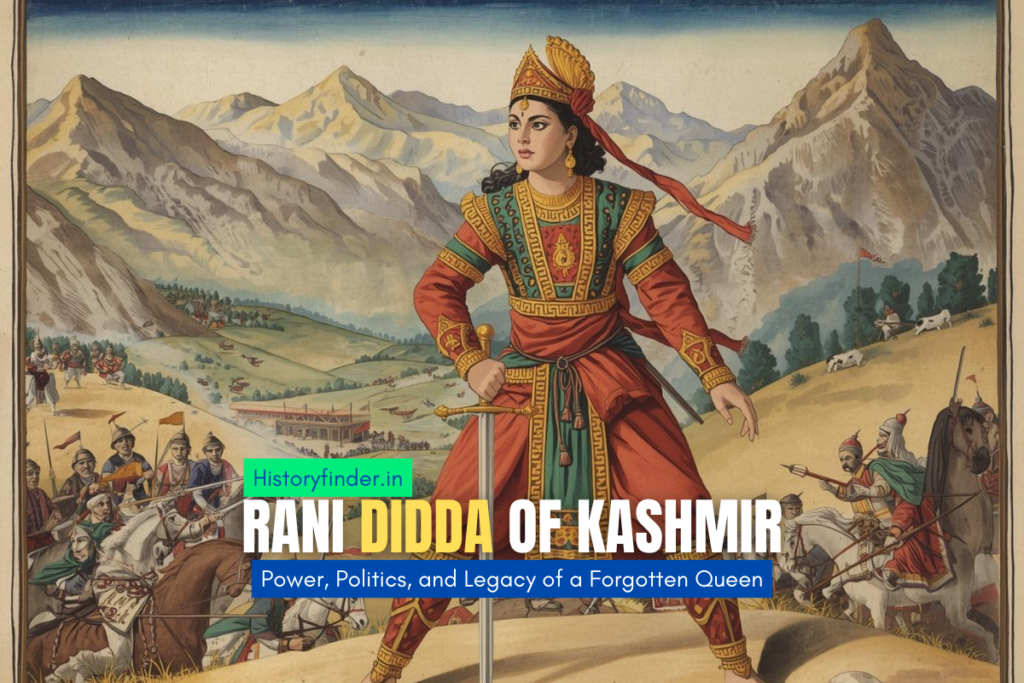
Early medieval Kashmir was politically vibrant and often unstable. Rani Didda of Kashmir emerged in this environment, where power depended not only on royal birth but also on political skill. To understand her rise, it is important to first examine the political climate of the kingdom she entered.
During the 10th century, Kashmir was ruled by the Utpala dynasty. However, royal authority had begun to weaken. Court factions had become stronger. Ministers, military leaders, and regional elites frequently shaped political decisions. As a result, succession disputes and palace intrigues became common features of governance.
Most of what we know about this period comes from Rajatarangini, the historical chronicle written by Kalhana in the 12th century. Kalhana describes a court where political alliances shifted quickly. Loyalty often depended on opportunity rather than tradition. Therefore, rulers needed strong political instincts to maintain authority.
Into this complex court arrived Rani Didda of Kashmir. She was born into the ruling family of Lohara. Later, she married the Kashmiri king Kshemagupta. Initially, Didda entered the kingdom as a queen consort. Yet the unstable political environment soon allowed her to gain greater influence in royal affairs.
Rani Didda story also highlights an important aspect of medieval Indian history. Women rarely ruled kingdoms directly. However, some royal women exercised considerable political authority. Rani Didda would eventually become one of the clearest examples of female leadership in this period. Her rise shows that political capability, not gender alone, shaped leadership in many medieval courts.
Thus, the turbulent court of Kashmir became the starting point of Rani Didda’s political journey. In the years ahead, she would transform her position from royal consort to one of the most powerful rulers in the history of Kashmir.
Rise of Rani Didda: From Queen Consort to Political Authority
The political rise of Rani Didda began after her marriage to Raja Kshemagupta, the ruler of Kashmir during the mid-10th century. At first, she entered the royal household as a queen consort. However, her position soon carried wider political significance.
Lohara, the paternal family stronghold of Rani Didda, was a strategically located region in the western Himalayan belt. Royal marriages in medieval India often served diplomatic and political purposes. Therefore, this alliance strengthened relations between Kashmir and Lohara while also enhancing Didda’s status within the royal court.
Because of this background, Didda did not arrive in Kashmir as an ordinary royal bride. Instead, she entered the kingdom with the prestige of a powerful lineage and a political network that would later prove valuable.
Evidence of Royal Authority in Coinage
One of the most interesting historical details about Didda’s early influence appears in numismatic evidence. Coins issued during the reign of Kshemagupta sometimes include references associated with the queen. This is significant because medieval coinage normally highlighted only the ruling king.
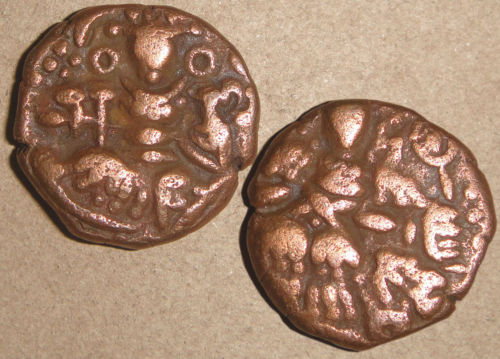
For historians, this detail suggests that Didda enjoyed an unusually visible political status for a queen consort. It indicates that her presence in governance may have been acknowledged publicly during the king’s lifetime. Such evidence strengthens the argument that her later authority did not appear suddenly but developed gradually during this period.
Rani Didda’s Role in the Kashmiri Royal Court
The political atmosphere of the Kashmiri court required constant negotiation among ministers, nobles, and military leaders. Within this environment, Rani Didda of Kashmir gradually developed influence.
According to the historical chronicle Rajatarangini, written by Kalhana, Didda possessed sharp political instincts. Kalhana’s narrative suggests that she actively observed court affairs and understood the balance of power among competing factions.
Although the chronicle was written more than a century later, it still provides valuable insights into her political personality. Many modern historians believe that Didda’s ability to read court politics during this phase, later helped her consolidate authority during times of instability.
Book Recommendation:
Kalhana’s Rajatarangini: A Chronicle of the Kings of Kashmir (In 3 vols.)
by M.A. Stein (Author)
[History Finder may earn some comission on effective sale of this book at no extra cost to the buyer.]
Overcoming Physical Challenges
Historical accounts also mention that Rani Didda lived with a physical disability affecting one of her legs. Despite this limitation, she maintained a strong presence in royal and political life.
In the context of medieval rulership, physical strength was often associated with kingship and leadership. Therefore, Didda’s political rise challenges common assumptions about power in that period. Her career suggests that leadership in medieval courts could depend more on strategic thinking and political alliances than on physical ability.
Preparing for Future Power
By the later years of Raja Kshemagupta’s reign, Didda had already gained familiarity with the structures of governance. She understood the roles of ministers, the influence of court factions, and the importance of loyalty within the ruling elite.
Consequently, when political instability emerged after the king’s death, Didda was not an inexperienced royal widow. Instead, she was a politically aware figure who understood how power functioned inside the Kashmiri court.
This stage of her life therefore represents the early foundation of the authority later exercised by Rani Didda of Kashmir. Her experience as queen consort prepared her for a much larger role in the kingdom’s political future.
Regency of Rani Didda: Rule on Behalf of the Throne
The death of Raja Kshemagupta around 958 CE created a delicate political situation in Kashmir. The throne passed to his young son Abhimanyu II, who was still a minor. As a result, effective power moved into the hands of the royal court and its influential ministers.
At this stage, Rani Didda of Kashmir assumed the role of regent. In medieval monarchies, regencies often produced intense power struggles. Ministers and regional elites frequently attempted to control the young king and influence state policy. Therefore, Didda’s regency immediately placed her within a highly competitive political environment.
The historical chronicle Rajatarangini by Kalhana describes this period as politically unstable. Court factions competed for influence, and loyalty within the administration remained uncertain. Consequently, the regent had to maintain constant control over court politics to preserve royal authority.
Didda as Regent for Abhimanyu
As regent, Rani Didda of Kashmir managed the practical responsibilities of governance. These responsibilities included overseeing the administration, maintaining relations with powerful nobles, and ensuring political stability during the minority of the king.
For historians, this phase represents the first period when Didda exercised direct authority in governance. Unlike ceremonial queenship, a regency required active political management. Decisions about administration, taxation, and military affairs increasingly passed through her control.
Kalhana’s narrative suggests that Rani Didda did not merely protect the throne for her son. Instead, she gradually strengthened her personal authority within the political structure. This development marked an important transition in her career—from influential queen consort to active political ruler.
Court Factions and Political Challenges
The Kashmiri court during this period contained several competing power groups. Ministers, military commanders, and regional elites often attempted to expand their influence. In such circumstances, regents frequently faced attempts to weaken their authority.
Historical descriptions indicate that Didda confronted these challenges directly. She worked to control influential ministers and reduce the power of rival factions within the court. Although Rajatarangini sometimes portrays her actions critically, many historians interpret them as pragmatic political measures.
From an analytical perspective, her approach reflects a broader pattern in medieval governance. Regents and rulers often had to act decisively to maintain political stability. Therefore, actions that appeared harsh in narrative accounts may also represent attempts to secure the throne during a fragile political phase.
Consolidation of Authority
Over time, the warrior queen of medieval Kashmir succeeded in strengthening her position within the Kashmiri political system. Her control over court politics gradually increased, while potential rivals lost influence.
This consolidation of authority reveals an important aspect of Rani Didda as a political leader of Kashmir. She understood that regency alone did not guarantee power. Instead, she worked to build alliances, weaken opposition, and maintain the authority of the throne.

For many historians, this period marks the true beginning of Rani Didda’s political dominance in Kashmir. Her ability to manage court factions and maintain stability demonstrates a level of strategic leadership rarely associated with medieval queens.
At the same time, her regency also highlights a broader historical point. Women in medieval India occasionally exercised substantial political authority when circumstances required capable leadership. Kashmir ki Rani Didda and her career stands as one of the clearest examples of such leadership in the history of the region.
Legacy of Rani Didda: A Powerful Queen in Kashmir’s History
Over time, Rani Didda moved beyond regency and exercised authority of Kashmir in her own right. After the death of her son Abhimanyu II, the throne passed to her grandsons. However, each of these rulers had short reigns. As a result, effective control remained with Didda.
Eventually, she assumed direct rule over Kashmir. This transition marked a significant shift. Instead of governing on behalf of another ruler, she became the central authority in the kingdom. For historians, this phase represents the peak of her political career.
From an analytical perspective, this development shows how regency could evolve into full sovereignty when supported by political control and administrative experience.
Establishment of the Lohara Dynasty
One of Didda’s most important political decisions was related to succession. Toward the end of her rule, she appointed her nephew Sangramaraja as her successor. He belonged to the ruling family of Lohara.
This decision led to the establishment of the Lohara dynasty in Kashmir. Through this transition, Didda ensured continuity of power while also strengthening ties with her native lineage.
The move reflects long-term political planning. Instead of allowing succession disputes, Didda managed the transfer of power in a controlled manner. Such decisions were crucial in maintaining stability in medieval kingdoms.
Governance and Political Stability
During her rule, Rani Didda maintained relative political stability of Kashmir— a region previously affected by factional conflict. By controlling court politics and managing noble power, she reduced internal instability.
Although detailed administrative records are limited, historical accounts suggest that her rule brought a degree of continuity to governance. This stability allowed the kingdom to function without major disruptions during her later years.
In medieval contexts, stability itself was a significant achievement. Rulers who could manage internal factions and maintain continuity often strengthened the long-term structure of the state.
Representation in Historical Sources
The legacy of Didda is closely tied to how she is described in Rajatarangini by Kalhana. There Kalhana provides detailed accounts of her political actions but often presents them with moral judgment.
Because of this, modern historians re-evaluate his narratives carefully. They compare his descriptions with broader patterns of medieval governance and political behavior.
This reassessment shows that historical interpretation can change over time. Actions once described negatively may be understood differently when placed within their proper political context.
Rani Didda and the Question of Women’s Power
The career of Rani Didda of Kashmir remains important in discussions of women’s leadership in medieval India. She governed a major kingdom for several decades and influenced its political direction.
Her rule demonstrates that women could exercise direct authority under certain conditions. It also shows that political leadership depended on strategy, alliances, and administrative control rather than gender alone.
Didda’s legacy challenges simplified views of medieval Indian society. Instead of a uniform system, it reveals a more complex structure where capable individuals could shape political outcomes.
Conclusion
Rani Didda stands out as one of the most significant political figures in the history of Kashmir. Her rise from queen consort to sovereign ruler reflects a gradual process shaped by political awareness, strategic action, and control over court dynamics.
Her legacy continues to attract historical interest because it combines multiple dimensions—power, governance, and gender. By examining her life through historical sources and analytical perspectives, it becomes clear that her rule was not an exception but part of the broader realities of medieval political systems.
Thus, the story of Rani Didda offers valuable insight into how authority was exercised and maintained in early medieval India. It also highlights the role that individual capability could play in shaping the course of regional history.
Frequently Asked Questions (FAQs)
Rani Didda of Kashmir was a powerful ruler of Kashmir in the 10th century. She first ruled as a regent and later became the sovereign ruler. The Queen Didda of Kashmir is known for her strong political control and long-lasting influence on the region.
Rani Didda of Kashmir ruled indirectly as regent after the death of Raja Kshemagupta around 958 CE. Later, she ruled directly until her death in 1003 CE. Her political influence lasted for several decades.
Rani Didda of Kashmir came to power after the death of her husband, Raja Kshemagupta. She became regent for her son Abhimanyu II, who was a minor. Over time, she consolidated authority and became the main political power in the kingdom.
Yes. Some accounts in Rajatarangini describe her actions against political rivals in a critical manner. However, modern historians often interpret these actions within the context of medieval political practices.
Yes. Historical sources mention that Rani Didda of Kashmir had a physical disability affecting her leg. Despite this, she ruled effectively and maintained strong political authority.