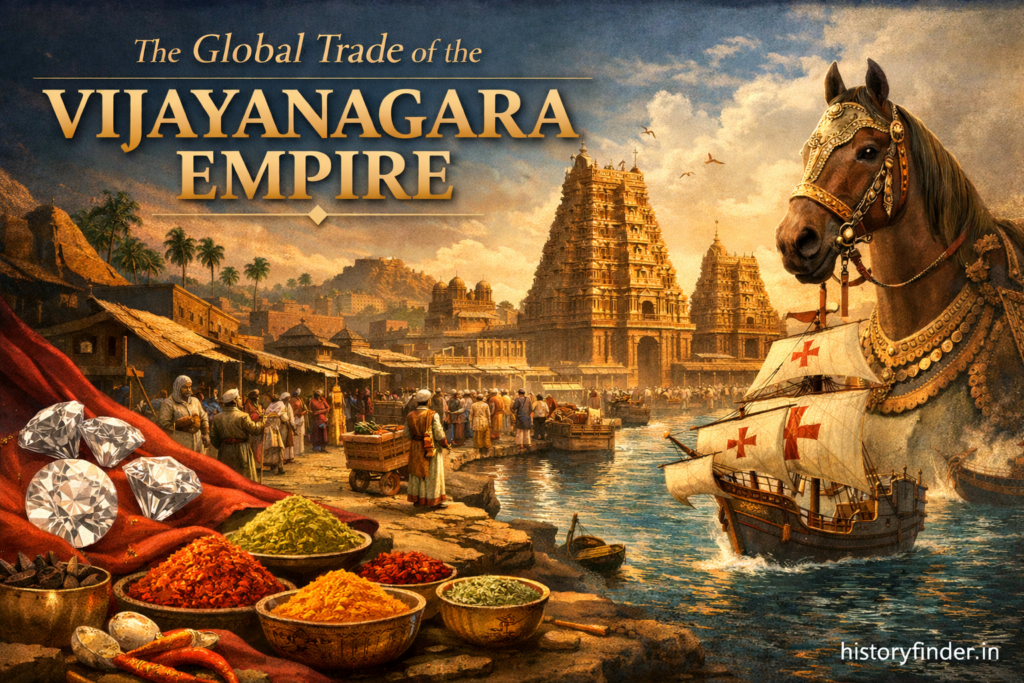
Trade shaped the strength of the Vijayanagara Empire as much as its armies and forts. From its capital at Hampi, the empire built one of the most powerful trade networks of medieval India. Diamonds from the Deccan, spices from fertile southern lands, and war horses from Arabia moved through Vijayanagara’s markets in large volumes. These goods connected the empire to ports, merchants, and kingdoms far beyond the Indian subcontinent.
The global trade of the Vijayanagara Empire was not accidental. It was the result of strategic geography, strong political control, and early economic vision. From the moment of its rise in 1336 CE, Vijayanagara positioned itself as a key link between inland India and international trade routes.
This article explores how ports, merchants, and exports turned Vijayanagara into a global commercial power of its time.
Ports That Sustained the Global Trade Network of Vijayanagara
The global trade of the Vijayanagara Empire depended heavily on its control over key ports along both coasts of India. Though the capital Hampi lay inland, the founders ensured strong access to maritime routes through a network of well-managed ports.
On the western coast, ports like Bhatkal, Honavar, Mangalore, and Goa played a crucial role. These ports connected Vijayanagara to the Arabian Sea trade system, linking South India with Arabia, Persia, and East Africa. Horses, dates, metals, and luxury goods entered the empire through these harbors.
On the eastern coast, Machilipatnam, Pulicat, and Nagapattinam acted as gateways to the Bay of Bengal trade routes. From here, Vijayanagara merchants traded with Southeast Asia, Sri Lanka, and China. Cotton textiles, rice, sugar, and spices flowed outward in large volumes.
What made this system effective was political control. Vijayanagara rulers did not always rule the ports directly, but they exercised influence through local chiefs and governors. Customs duties were regulated. Merchant safety was ensured. Trade routes were protected. Foreign travelers often noted the smooth movement of goods from ports to inland markets. Well-maintained roads and river routes linked coastal centers to Hampi. This integration turned the capital into a major commercial hub, despite its distance from the sea.
The success of Vijayanagara’s ports shows that the empire’s founders understood trade from the very beginning. Economic strength was treated as a pillar of imperial power, not an afterthought.
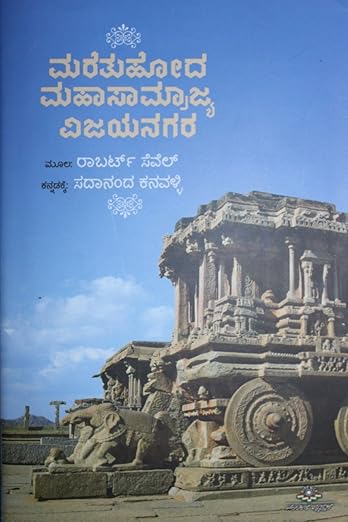
Recommended Reading on Vijayanagara Trade & Ports
Disclosure: Above products are having Amazon affiliate links. If you choose to purchase through them, historyfinder.in may earn a small commission at no extra cost to you.
Merchants and Guilds Behind Vijayanagara’s International Trade
Trade in the Vijayanagara Empire was shaped by deliberate royal policy. The rulers understood that economic stability depended on organized merchants. Hence they emphasized on protecting the trade routes.
During the reign of Harihara I and Bukka Raya I, early merchant guilds such as the Ayyavole (Ainurruvar) and Manigramam received royal support. Inscriptions from Karnataka and Andhra regions show that these guilds managed long-distance trade and paid taxes directly to the state. In return, they were granted protection and autonomy. As a result, commerce recovered quickly in post-invasion South India.
Under Deva Raya I (1406–1422), trade regulations became more structured. He improved roads connecting ports to inland markets and encouraged foreign merchants to settle in trading centers. Persian and Arab traders were allowed to follow their own customs, which strengthened trust and continuity in trade.
The empire’s commercial power reached new heights during the reign of Krishnadevaraya (1509–1529). Portuguese records clearly mention his active interest in overseas trade. He ensured a steady supply of Arabian horses, vital for his army, by maintaining strong ties with Portuguese merchants on the western coast. At the same time, exports of cotton textiles and precious stones expanded significantly.
Foreign travelers like Domingo Paes and Fernao Nuniz described the bustling markets of Hampi during Krishnadevaraya’s rule. According to them, markets were strictly regulated. Weights and measures were standardized. Dishonest trade was punished. Therefore, Vijayanagara earned a reputation as a safe and reliable trading empire.
Even in later periods, rulers such as Achyuta Deva Raya continued supporting merchant communities. Although political challenges increased, trade networks remained active.
Key Exports and Imports in the Global Trade of Vijayanagara
The strength of the Vijayanagara trade network rested on a balanced exchange of exports and imports. From its early years, the empire focused on supplying high demand goods while securing strategic imports essential for power and stability.
Exports That Enriched the Empire
The most famous export of Vijayanagara was diamonds. The mines of the Deccan, especially around the Krishna–Tungabhadra region, produced precious stones. Vijayanagara economy flourished by selling them in the markets across West Asia and Europe. Foreign travelers repeatedly mentioned the abundance and quality of these diamonds.
Alongside gems, cotton textiles formed the backbone of export trade. Fine fabrics woven in the interior were shipped through coastal ports to Southeast Asia, Arabia, and Africa. These textiles were valued for their durability and craftsmanship.
Spices, rice, sugar, and areca nut were also exported in large quantities. The fertile river valleys under Vijayanagara control ensured consistent agricultural surplus. As a result, trade remained stable even during political fluctuations.
Strategic Imports That Sustained Power
Among all imports, Arabian and Persian horses were the most crucial. South India lacked suitable horse-breeding conditions. Therefore, Vijayanagara kings depended heavily on overseas imports to maintain cavalry strength. Kings like Krishnadevaraya personally supervised horse trade agreements, as noted in Portuguese records.
Other imports included metals, luxury goods, and weapons. Pearls, coral, and fine glassware entered the empire through western ports. These items circulated among elites and temples, reinforcing royal prestige.
A Carefully Managed System
Importantly, this trade was not left unregulated. Customs duties were imposed. Quality was monitored. Merchants operated under royal oversight. Because of this structured approach, Vijayanagara’s markets gained international trust.
Thus, exports generated wealth, while imports strengthened military and cultural power. This careful balance explains why Vijayanagara remained economically resilient for centuries.
How Global Trade Revenue Strengthened Vijayanagara’s Military Power
Trade wealth directly strengthened the military power of the Vijayanagara Empire. Unlike many contemporary kingdoms, Vijayanagara did not rely only on land revenue. Instead, income from trade allowed its rulers to build and sustain a large, professional army.
One of the clearest examples was the import of Arabian and Persian horses. Cavalry formed the backbone of medieval warfare. However, South India could not breed strong war horses. Therefore, Vijayanagara kings used trade profits to secure a steady supply from overseas markets. Portuguese accounts note that kings like Krishnadevaraya paid premium prices to ensure quality and regular imports.
Trade wealth also funded a strong standing army. Soldiers were paid regularly. Weapons were upgraded. Fortifications were maintained. As a result, the empire could respond quickly to threats from the Deccan Sultanates and regional rivals.
Moreover, commercial revenue supported advanced defensive architecture. Massive forts, watchtowers, and city walls were built across the empire. Hampi itself was surrounded by layered defenses, combining natural terrain with fabricated structures. These constructions required skilled labor and steady funding, both supplied by trade income.
Importantly, trade also influenced military diplomacy. Control over ports and trade routes gave Vijayanagara leverage in negotiations. Alliances were formed. Rivals were economically weakened. Thus, commerce became a silent weapon of statecraft.
Over time, this close link between trade and military power created stability. Economic strength sustained military readiness. Military protection, in turn, secured trade routes. This cycle explains how Vijayanagara maintained dominance for nearly three centuries.
Trade Administration and Commercial Infrastructure of Vijayanagara
Trade in the Vijayanagara Empire was never left to chance. From its early years, the state actively protected merchants, ports, and trade routes. This policy ensured a steady flow of revenue into the imperial treasury.
Major ports such as Bhatkal, Honavar, Barkur, Goa, and Machilipatnam acted as gateways between Hampi and the wider world. Goods moved inland along river routes and well-guarded highways. Inscriptions from the reigns of Deva Raya I and Krishnadevaraya frequently mention customs duties, port officials, and merchant guilds. These records confirm how closely trade was tied to state administration.
Merchant communities enjoyed royal patronage. In return, they financed temples, markets, and even military campaigns. Guilds dealing in horses, textiles, and precious stones were especially influential. Persian and Portuguese accounts note that foreign traders operated freely, yet under strict royal supervision.
The Vijayanagara Empire also invested heavily in infrastructure. Roads were repaired. River crossings were secured. Warehouses and market streets were planned near temple complexes. As a result, commerce remained stable even during periods of war.
This close partnership between the crown and the trading world explains why Vijayanagara’s economy stayed resilient. Trade wealth did not merely enrich the empire. It powered its armies, strengthened its administration, and sustained its long resistance against rival sultanates.
Temple Cities as Centers of Trade and Commerce in Vijayanagara
In the Vijayanagara Empire, temples were not only the centers of worship. They functioned as economic engines that sustained urban life. From the very birth of the empire, this model was consciously adopted.
Major temple cities such as Hampi, Tirupati, Srirangam, and Kanchipuram became vibrant commercial zones. Wide market streets, known as bazaar veedhis, developed around temple complexes. Foreign travelers like Domingo Paes described long, organized bazaars filled with spices, textiles, gems, and food supplies near the Virupaksha Temple.
Temple endowments played a key role. Kings and nobles donated land, gold, and revenue from villages. These funds paid priests, artisans, guards, and traders. As a result, a steady circulation of money kept local economies active.
Craft communities flourished around temples. Stone carvers, bronze workers, weavers, and jewelers settled nearby to meet ritual and urban demand. This created employment and attracted merchants from distant regions. Over time, temple towns evolved into permanent economic centers.
Temples also acted as financial institutions. Virupaksha and Tirupati temple inscriptions record loans given from temple treasuries to traders and farmers. Interest from these loans funded festivals and maintenance. Thus, religion and commerce remained closely linked.
This system explains why Vijayanagara’s urban economy stayed strong. Even during political tensions, temple-centered trade kept cities alive. The empire’s founders understood that spiritual authority and economic stability worked best together.
Foreign Accounts of Markets and Trade in Vijayanagara
Foreign travelers often viewed temple markets as a clear reflection of the global trade of the Vijayanagara Empire. To them, these spaces showed how religion, commerce, and urban life worked together in South India.
The Persian envoy Abdur Razzak, who visited Vijayanagara in the 1440s, described Hampi as a city surrounded by busy bazaars near major temples. His account highlights how temple-centered markets supported long-distance trade. According to him, goods from different regions were exchanged daily, proving the international character of Vijayanagara’s commerce.
Italian traveler Niccolò de’ Conti also noted the scale of trade around temple towns. He observed that pilgrimage centers attracted merchants from across Asia. This constant movement of people and goods strengthened the global trade network of the Vijayanagara Empire, even before its political peak.
The most detailed observations come from Domingo Paes, who visited during the reign of Krishnadevaraya. He described long market streets near the Virupaksha Temple, filled with jewels, spices, textiles, and horses. His writings show how temple markets functioned as key nodes in the global trade of the Vijayanagara Empire, linking inland Hampi with coastal ports.
Together, these foreign accounts confirm a larger pattern. Temple markets were not local bazaars alone. They were vital engines of the global trade system of the Vijayanagara Empire, admired by visitors from Persia, Europe, and beyond.
Portuguese Role in the Global Trade of the Vijayanagara Empire
The arrival of the Portuguese marked a new phase in the global trade of the Vijayanagara Empire. When the Portuguese reached the western coast of India in the early 16th century, they quickly recognized Vijayanagara as the dominant inland power of South India.
Portuguese traders established strong commercial ties with Vijayanagara through ports such as Goa, Bhatkal, and Honavar. Although these ports were not always under direct imperial rule, the empire exercised political influence over them. This allowed trade to continue with relative stability.
One of the most critical aspects of Portuguese–Vijayanagara trade was the horse trade. War horses from Arabia and Persia arrived through Portuguese-controlled sea routes. In return, the Portuguese received textiles, spices, rice, and precious stones. Kings like Krishnadevaraya personally monitored these exchanges, understanding their importance for military strength.
Portuguese chroniclers repeatedly described the wealth of Vijayanagara. They noted well-regulated markets, strict trade rules, and royal oversight. Unlike many contemporary states, Vijayanagara welcomed foreign merchants while maintaining control over commerce. As a result, mutual economic benefit defined the relationship.
However, this relationship remained practical rather than political. Vijayanagara rulers used Portuguese trade to counter Deccan Sultanates, while carefully avoiding foreign dominance. Trade served strategy, not dependence.
In this way, Portuguese engagement strengthened the global trade network of the Vijayanagara Empire without undermining its sovereignty. The partnership shows how early modern maritime powers interacted with established Asian empires on negotiated terms.
Conclusion: Global Trade as the Backbone of Vijayanagara Power
The rise of the Vijayanagara Empire cannot be understood without its trade. From its foundation in 1336, the empire treated commerce as a pillar of power, not a secondary activity.
The global trade of the Vijayanagara Empire linked inland Hampi with ports on both coasts. Through this network flowed diamonds, textiles, spices, and agricultural goods. In return came horses, metals, and luxury items that strengthened military and royal authority. This balance created lasting economic stability.
Trade wealth funded armies, forts, and administration. It sustained temple cities and supported merchant guilds. At the same time, strong military protection kept trade routes secure. This mutual dependence formed a self-reinforcing system.
Foreign travelers, from Abdur Razzak to Portuguese chroniclers, repeatedly admired this prosperity. Their accounts confirm that Vijayanagara was not an isolated kingdom. It was an active participant in the wider medieval world.
In the end, Vijayanagara’s success lay in vision. By aligning geography, trade, and governance, its founders built an empire where commerce powered culture, diplomacy, and defense. That legacy remains one of the most remarkable chapters in Indian history.
Frequently Asked Questions
Trade brought immense wealth through diamonds, spices, and horses, which strengthened Vijayanagara’s economy and military.
Diamonds, spices, textiles, and imported war horses were the most important trade commodities.
Arab, Persian, Chinese, and Portuguese traders were actively involved in Vijayanagara’s global trade network.
Temple cities functioned as commercial hubs, offering markets, storage, and financial support to traders.
Ports like Bhatkal, Honnavar, and Goa connected the empire to the Indian Ocean trade routes.
Travelers praised the vast markets, rich trade goods, and orderly commercial life of the empire.
You May Also Like

Nalanda University History – The Lost Intellectual Capital of Asia
Historical Value of the Rig Veda as a Source of Early Indian History

History of Delhi: Rise, Destruction, and Rebirth of India’s Eternal Capital

Establishment of the Delhi Sultanate: How a New Era Began in India
The Making of Raigad: The Capital of Chhatrapati Shivaji Maharaj
Rajput Kingdoms: History, Culture, Dynasties and Their Legacy
History of the Maratha Empire: Rise, Expansion, and Fall of a Powerful Confederacy
How Vijayanagara Empire Was Born: History of A Grand Revival