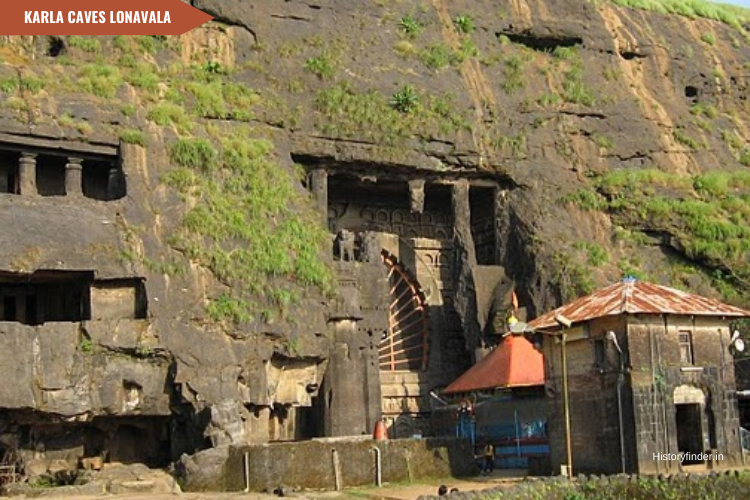
The Karla Caves, located near Lonavala in Maharashtra, are among the finest surviving early Buddhist rock‑cut architecture in India. Maharashtra, although, is extremely rich in rock-cut Buddhist Caves, but the Karla Caves stand apart because of their scale, age, architectural detailing, and inscriptions. Carved deep into the rocky slopes of the Western Ghats, the Karla Caves history reveals centuries of monastic life, craftsmanship, and spiritual practice.
At the heart of the Karla Caves lies the Great Chaitya, one of the largest and best‑preserved Buddhist prayer halls in India. Its vast interior, stone‑carved ribs, and towering stupa reflect the architectural ideals of early Buddhism. The caves also bear inscriptions from merchant guilds and Satavahana rulers, glorifying the centuries old history of the Karla Caves near Lonavala. At the same time, it also showcases how trade networks and royal patronage supported the spread of Buddhism across western India.
Today, Karla Caves continue to draw visitors for their artistic beauty, historical depth, and cultural significance. Their halls, carvings, and façades still echo the world of ancient monks who once lived, prayed, and taught within these stone‑cut chambers. Today, the Archaeological Survey of India (ASI), protects the monuments of Karla, as a Buddhist heriatge in India.
How Karla Caves Differ from Other Buddhist Rock‑Cut Caves in Maharashtra
Pune and Aurangabad districts of Maharashtra are extremely rich with Buddhist caves. The rock-cut caves of Ajanta and Elora of Aurangabad are world famous for astonishing Buddhist arts. While the caves of Bhaja and Bedse are also quite famous Buddhist heritages near Pune and Lonavala region. But Karla offers a distinct identity shaped by early patronage, engineering ambition, and the evolution of Buddhist art.
The most striking difference of Karla is the Great Chaitya Hall, locally famous as Karle Chaityagriha. It is one of the largest and best‑preserved early Buddhist prayer halls in India. The long central nave, tall pillars, and high vaulted ceiling are more monumental than those in Bhaja or Bedse. Further, the wooden‑ribbed ceiling design, partially surviving since the 1st–2nd century CE, adds a lot of historical significance. Such preservation of ancient wooden elements is extremely rare in most other cave complexes.
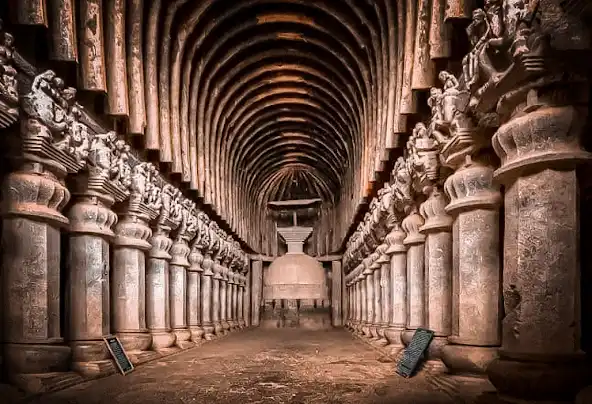
Another difference is scale and complexity of Karla. The chaitya at Karla is larger, wider, and more acoustically balanced than those in nearby caves. The façade, with its grand horseshoe‑shaped window, exhibits deeper, sharper, and more mature carvings than the earlier rock‑cut works of Bhaja or the simpler façades at Bedse. The proportions of Karla’s chaitya reflect a late phase of Hinayana architecture, where architectural knowledge had reached a high level of refinement.
Karla also differs in the breadth of donor inscriptions. Merchant guilds who contributed to the construction, has left their records of trade networks and monastic connections. While caves like Bhaja and Bedse contain inscriptions, Karla’s are more numerous and show a more diverse set of patrons, including Satavahana rulers, traders, monks, and artisans. This makes Karla an important archaeological record of early Buddhist economic influence in western India.
Origins and Early History of Karla Caves
Impeccably, the history of Karla Caves stretches back over 2,000 years. The earliest sections of the complex are datable to the 2nd century BCE. It was the time when Buddhism spread across western India through trade routes along the ghats. Buddhist monks transformed these caves into monasteries to live, meditate, and teach Buddhism as the way of life.
Interestingly, the selection of the location of Karla Caves was more strategic, on the ancient Dakshinapatha trade route. The ancient trade route connected the west coast to the Deccan. As a result, Karla Caves served as a natural resting point for travellers and merchants. These traders often became donors, contributing funds for cave excavation, pillars, beams, and interior decorations. Their inscriptions remain carved into stones, preserving names of guilds and benefactors who supported the monastic community.
Valuraka or Veluraka was the ancient name of Karla Caves. Karla being a natural cave, Buddhist monks found this place easier for excavation. Karla or Karle Caves just rises about 45 meters height. Which means, it was an easy access to the visitors as well.
Karla Caves represent a group of 16 old Buddhist caves. Majority of the caves are datable to Hinayana phase, typically from ‘Before Common Era’ (BCE). Only 3 caves belong to the Mahayana phase datable to Common Era (CE).
Satavahana Patronage and Donor Inscriptions
The Satavahana dynasty, which ruled much of western and central India from around the 1st century BCE to the 2nd century CE, played a major role in supporting Karla Caves. The Great Chaitya, in particular, bears several inscriptions from Satavahana rulers who granted land, funds, and resources for its construction. Honestly speaking, constructions like the great Chaitya was anyways not possible without any royal sponsorship.
Satavahana support allowed the caves to flourish as a centre of Buddhist teaching. Merchant guilds from regions such as Nashik, Kalyan, Paithan, and Sopara also contributed. Their inscriptions mention donations for pillars, windows, and roof beams carved in stone. These inscriptions confirm that Karla was a vibrant hub where religion, trade, and culture intersected.
Inscriptions of Karla Caves
Karla Caves are bearing about 22 inscriptions, all in Brahmi scripts, unfolds an imposing history of donations to the monastery. The inscriptions include the names and places of donors, mostly by royal families, merchants etc. Karla Cave inscriptions clearly speak about 27 individuals from various places.
Yavanas (Indo-Greek rulers) of Denukakata and Umehanakata had donated six of the Great Chaitya Griha pillars of Karla Caves. Those pillars still bear the names and locations of the Yavana donors. Dhenukakata is assumed to be Danahu, about 200 kilometers northwest to Karla Caves. Town of Umehanakata is however still unknown.
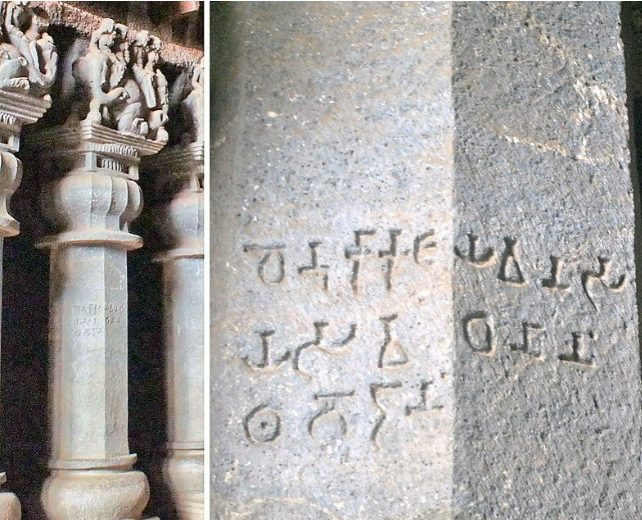
The Kshatrapa Nahapana inscription, appears on the lintel to the right of the Great Chaitya entrance. It elaborates the major charities made by the king to the monks living in the caves. The left lintel of Great Chaitya entrace bears an inscription of charity made by Satavahana king Sri Pulumavi (130-159 CE). Pulumavi inscription mentions about the donation of land to the Veluraka Samgha.
Both inscriptions at the Great Chaitya entrace gate mentioned about Valuraka, the ancient name of Karla Caves.
Role in expanding Buddhism
Buddhist monasteries of Karla and Bhaja provided resting facilities to the passing travellers. Monks would narrate the glory of Gautama Buddha’s life and achievements to the resting travellers. They would also provide all important insights into the life and belief system of Buddhism which impressed the travellers a lot.
Karla Caves served as one of the key Buddhist schools, spreading Buddhism in ancient times. The inscriptions and architectures of Karla suggest how the local rulers and merchants supported Buddhism.
Karla Caves Architecture
Karla Caves are carved entirely out of volcanic basalt rock. From the structural standpoint, Karla Caves are very similar to Bhaja Caves. Their design follows traditional Buddhist cave architecture. The chaityas served as prayer halls and the viharas served as living quarters. The architectural style combines structural ambition with artistic detail.
The entrance of the cave complex features a grand horseshoe‑shaped window—an iconic symbol of early Buddhist chaitya halls. Such an opening allows sunlight to enter the prayer hall, creating a dramatic play of light on the interior pillars and stupa. Rows of pillars, carved with simple motifs, line the hall and guide the gaze toward the central stupa, the symbolic focus of worship.
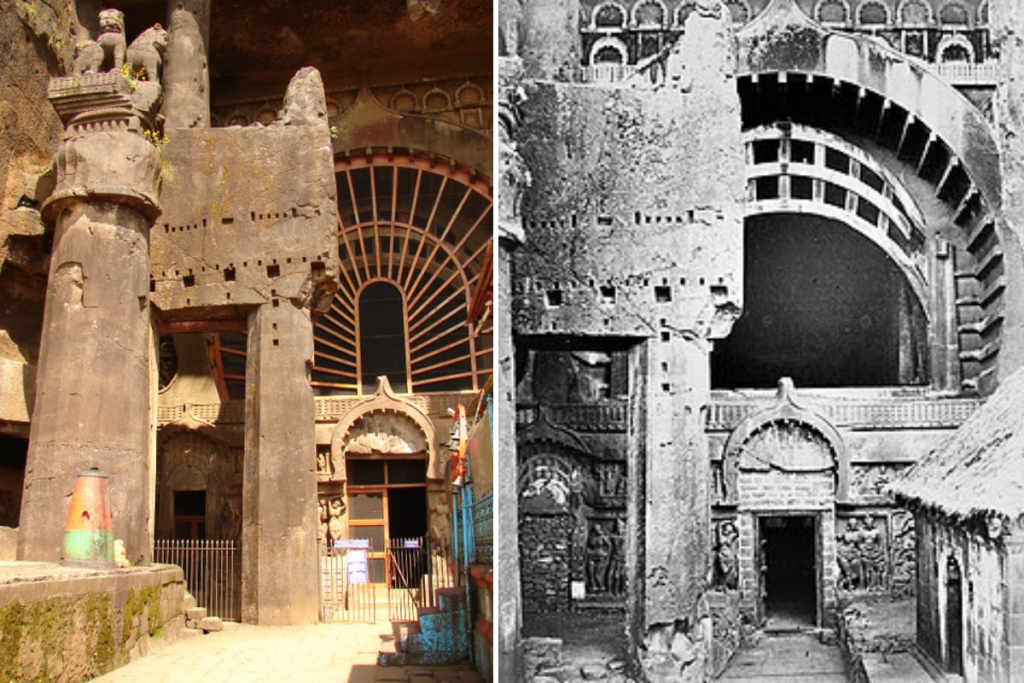
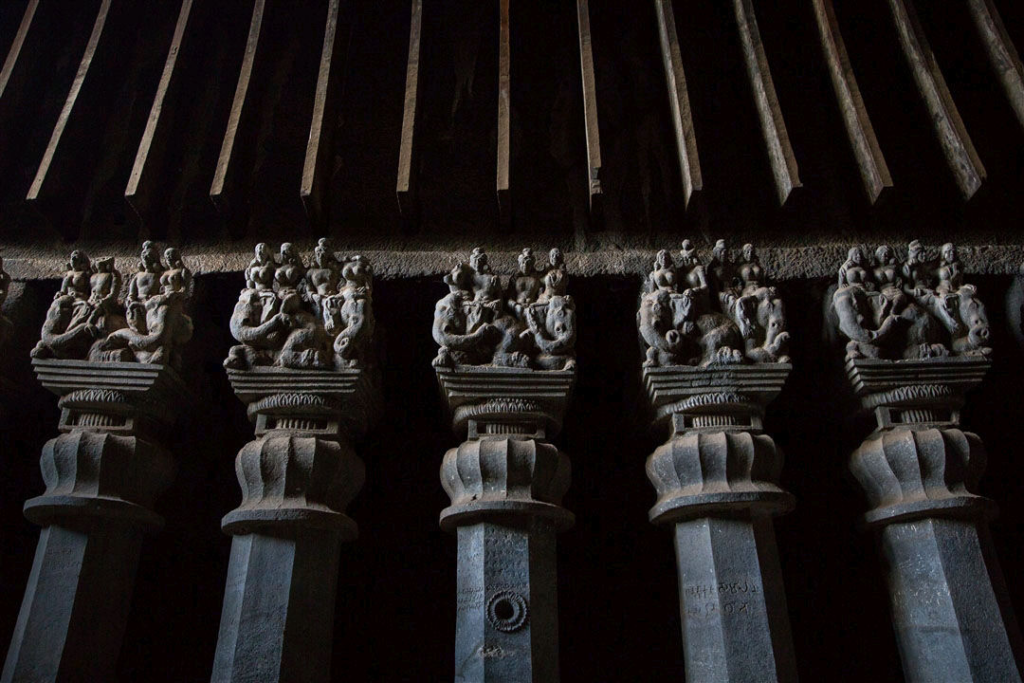
Chaitya architecture of Karle Caves predominantly consists of arched entrances and vaulted interiors. Two rows of stone pillars bear the stone beams. Rib shaped wooden structures, standing on the stone beams, support the stone ceiling. Stone pillar often carry the names and other details of the donors. Cave 8 of Karla is the largest chiatya in India, hence often recognised as the Great Chaitya.
Karla also contains several viharas, which include stone platforms for sleeping, assembly spaces, and smaller meditation cells. These areas show how monks lived and interacted with visiting traders who sought spiritual guidance.
Viharas have completely different architecture and application in Buddhist monasteries. Karla Caves Viharas consist of small cells or chambers where the Buddhist monks lived. One of the Vihara cells also consists an inscription of Satavahana king Vasishthiputra Pulumavi.
Great Chaityagriha of Karle Caves
Karla Caves Great Chaityagriha (cave 8), measures about 45 meters (148 feet) in length and also rises to a height of 14 meters (46 feet). The largest rock-cut Buddhist prayer hall of ancient India is also notable for its splendid architecture.
The entrance of Great Chaitya cave is greeted by the iconic stone pillar on the left. It however looks like a plain shaft with sixteen flutes. But the pillar capital with four lions made it recognizable. It may had its pair on the right side. But probably removed to make space for the temple appears now. Some experts also say that the other pillar may had collapsed before the temple was constructed.
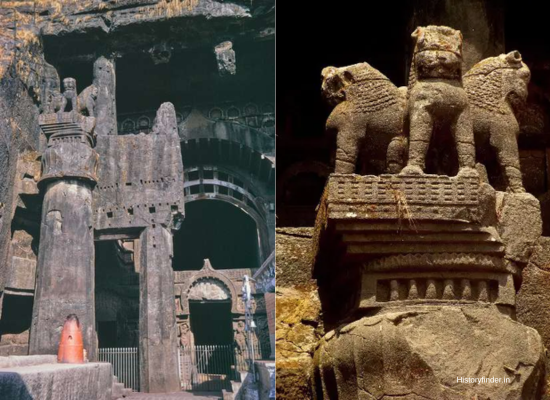
The entrance, consists of three dateways, one leading to the central hall, while others to the each of the side-aisles. Over the gallery, the whole end of the Great Chaitya hall is open, forming a single great window.
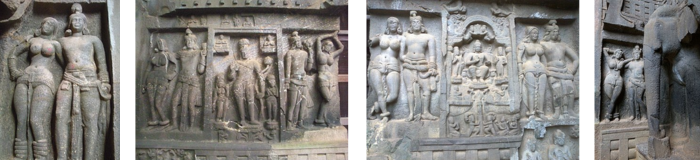
The sculptures at both sides of the entrance doors represent classic Buddhist arts. However, such physical forms of Buddha arrived during Mahayana phase, much later than the cave’s excavation.
Fifteen pillars on each side divides the cave into 3 sections: the central hall and narrow aisles on both side of it. Each pillar consists of a tall base, an octagonal shaft, and a richly ornamented capital. The capitals depict males and females riding lions, elephants, and other animals. A giant rock-cut stupa appears at the center but to the back end of the cave. Details of donors are inscribed at the pillars in Brahmi scripts.
Large horseshoe-shaped wooden rib beams supporting the ceiling, represent classic wooden architecture of 1st century BC. This ceiling architecture is almost identical to Chaitya Griha of Bhaja Caves. Horse-shoe windows allow Sunlights illuminate the interiors.
Architectural Development in Chronology
The Great Chaitya cave architecture of Karla has followed rather improved on other Chaitya caves nearby. Chronological analysis gives a clear picture how Chaitya Caves improved over the period. It probably started from Cave 9 of Kondivite Caves, followed by Cave 12 of Bhaja Caves and Cave 10 of Ajanta Caves around the 1st century BCE. Then it further continued with Cave 3 of Pitalkhora, Cave 1 of Kondana Caves, Cave 9 at Ajanta built about a century later. These caves showcased more ornate designs. Cave 18 of Nasik Caves to Cave 7 of Bedse Caves which finally arrived at the Great Chaitya at Karla Caves.
Therefore the Great Chaitya, the cave 8 of Karla, often referred as ‘final perfection’.
Cultural Legacy of Karla Caves
Karla Caves represent one of the earliest and most influential phases of Buddhist architecture in the subcontinent. Their design influenced later cave complexes such as Bhaja, Bedse, Nashik, Kanheri, and Ajanta. For travellers, the caves were a symbol of refuge and learning; for monks, they formed a centre of meditation and teaching.
Today, Karla stands as a protected monument that continues to connect modern visitors with the spiritual and artistic traditions of ancient India. The Great Chaitya still inspires awe, reminding people of the enduring legacy of early Buddhist culture.
FAQ — Karla Caves
The earliest caves date to the 2nd century BCE, with major expansions in the 1st–2nd century CE.
The Satavahana dynasty and local merchant guilds provided major patronage.
Chaitya or Chaityagriha is known as Buddhist prayerhalls. Karle Caves Chaityagriha is one of the largest surviving Buddhist prayer halls, featuring a stupa and a vaulted ceiling with carved ribbed beams in India.
Karla or Karle Caves are located near Lonavala, off the ancient trade routes connecting the Konkan coast with the Deccan.
You May Also Like

Nalanda University History – The Lost Intellectual Capital of Asia
Historical Value of the Rig Veda as a Source of Early Indian History

History of Delhi: Rise, Destruction, and Rebirth of India’s Eternal Capital

Establishment of the Delhi Sultanate: How a New Era Began in India
The Making of Raigad: The Capital of Chhatrapati Shivaji Maharaj
Rajput Kingdoms: History, Culture, Dynasties and Their Legacy
History of the Maratha Empire: Rise, Expansion, and Fall of a Powerful Confederacy

Diamonds, Spices, and Horses: Global Trade of The Vijayanagara Empire

How Vijayanagara Empire Was Born: History of A Grand Revival

Chanakya and Nanda Dynasty: Ancient India’s History Changing Strategies

Chandragupta Maurya and Chanakya: Rise of the Mauryan Empire